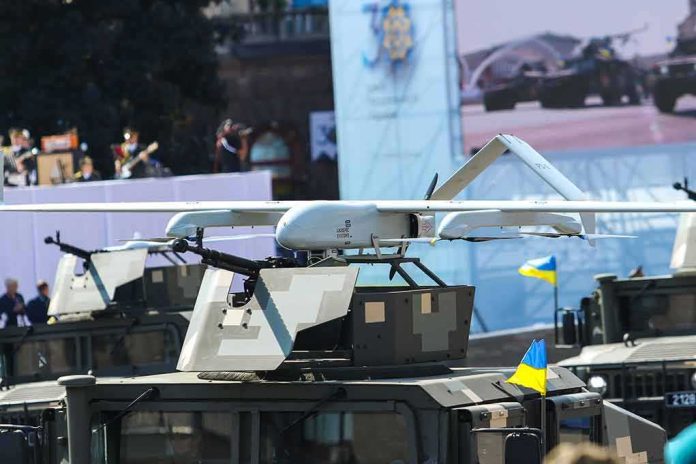
Ukraine’s largest-yet drone barrage lit fires at a Moscow oil refinery as Russia reported two deaths during its election finale.
Story Highlights
- Officials said more than 1,000 Ukrainian drones targeted Russia overnight, with hundreds aimed at Moscow.
- Moscow’s mayor said air defenses intercepted 450 drones headed toward the capital.
- Russian authorities reported two deaths and damage at a Moscow oil refinery.
- Russia’s Defense Ministry claimed over 1,100 drones were shot down across the country.
What Happened During The Overnight Barrage
Ukrainian forces launched more than 1,000 drones at Russia overnight, including hundreds directed at Moscow, according to officials and major outlets tracking the war. The attack coincided with the final day of Russia’s parliamentary elections, heightening the political stakes in Moscow and beyond. Russian officials reported that at least two people died in the Moscow region, and images shared by media showed smoke at an oil refinery site inside the capital. Ukraine did not detail individual targets in immediate public statements.
Moscow Mayor Sergei Sobyanin called the wave the largest attack on the capital to date, and said air defenses intercepted 450 drones headed toward the city. Russia’s Defense Ministry said its forces shot down more than 1,100 Ukrainian drones across Russia, Crimea, and the Black Sea in the same period. Sobyanin also said several drones still reached the grounds of a Moscow oil refinery and a residential building, causing damage inside the city. Officials and outlets differed on total injuries reported.
Damage And Civilian Impact Inside Russia
Russian officials said the barrage killed two people in the Moscow region and injured others, with counts that varied across outlets. Authorities reported a strike at the Moscow Oil Refinery in the Kapotnya district, a site already targeted in past waves, raising concerns about energy infrastructure risk inside Russia’s capital region. The mayor’s posts described damage at the refinery and an apartment building. The size of the drone wave, and the fact that some reached city facilities, underscored limits in layered air defenses despite high intercept totals.
Russian agencies framed the operation as an attempt to disrupt the vote, claiming that the “enemy failed” to affect election procedures. That claim reflects an information battle that runs alongside the air war. In past exchanges, both sides have released large numbers for launches and interceptions that are hard to verify quickly. Major wire services and broadcasters often rely first on official statements before independent checks or satellite reviews catch up, if they do at all. Readers should expect revised counts as more data emerges.
Why The Drone War Is Escalating Now
Ukraine has steadily scaled up long-range strikes to stretch Russian air defenses, drain resources, and hit fuel and logistics hubs far from the front. Public data and prior reporting show waves against Moscow have shifted from rare to regular, with the capital’s oil and industrial sites now frequent targets. Russia has also increased its own drone and missile use against Ukraine, seeking to pressure cities and energy networks. The result is a race of production, adaptation, and cost across both sides’ economies.
🚨 MASSIVE ATTACK: Ukraine launched a record-breaking drone strike targeting the Russian capital. Russian authorities say over 1,600 drones were intercepted, with 450 aimed at Moscow.
A major fire broke out at the Moscow Oil Refinery after multiple drones struck the facility. pic.twitter.com/MmaLQdnmI6— Muhammad Rizwan (@m_rizwanjamil) September 20, 2026
For Americans watching, the lesson is not only military. Drone swarms are cheap compared to missiles, yet they can spark fires at key sites, rattle major cities, and force huge air-defense spending. That cost spiral should concern taxpayers in every country backing either side. When leaders talk tough but dodge hard questions on budgets, energy security, and supply chains, everyday people pay the tab. Clear goals, honest oversight, and transparent metrics are vital to avoid endless commitments without clear results.
Sources:
redstate.com, usnews.com, english.mathrubhumi.com, srpske.rs