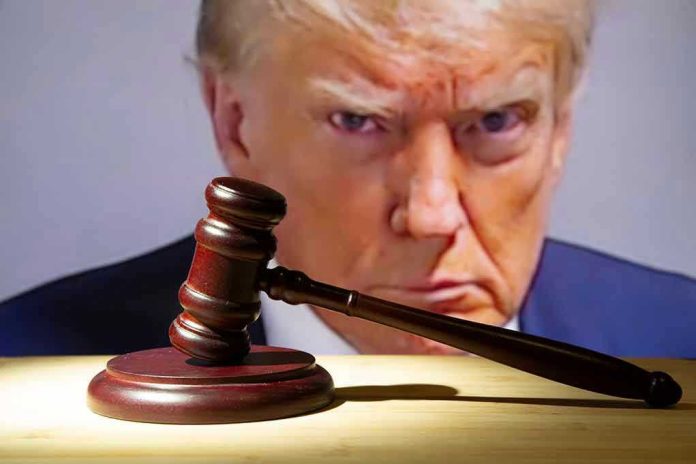
President Trump’s relentless push to dismantle the Senate’s “blue slip” tradition has sparked a fierce debate, leaving many to wonder if this could reshape the future of judicial confirmations.
At a Glance
- Trump urges Senator Grassley to abolish the Senate’s blue slip tradition.
- The blue slip allows senators to block judicial nominees in their states.
- Grassley resists, emphasizing the importance of Senate traditions.
- The debate highlights tensions within the Republican Party.
Trump’s Bold Campaign Against Senate Tradition
President Donald Trump is on a mission to eliminate the Senate’s “blue slip” tradition, which allows home-state senators to block federal judicial nominees. This move is aimed at accelerating the confirmation of his judicial picks by removing a procedural hurdle that often gives the minority party veto power. Trump has taken this fight public, using social media to urge Senate Judiciary Committee Chairman Chuck Grassley to end the practice. Grassley, however, remains steadfast in his commitment to this tradition, prioritizing bipartisan input over party pressure.
Trump tells Sen. Chuck Grassley to ‘step up,’ get rid of ‘ridiculous custom’ holding up judicial appointments https://t.co/qCcsym22DI pic.twitter.com/ItGUAvJMVC
— New York Post (@nypost) July 30, 2025
The blue slip tradition, which dates back to 1917, has been a point of contention, especially when the Senate and presidency are controlled by different parties. Grassley previously ended the blue slip for circuit court nominees during Trump’s first term but has retained it for district court judges and U.S. attorneys. Trump’s renewed push comes amidst a series of controversial judicial nominations, including the recent confirmation of Emil Bove to the 3rd Circuit Court of Appeals.
Grassley’s Stance and Party Division
Despite Trump’s public pressure, Grassley has made it clear that he intends to uphold the blue slip tradition for district court nominees. Grassley, known for his longstanding commitment to Senate traditions, argues that the blue slip is essential for maintaining bipartisan cooperation and a check on executive power. This stance has created a rift within the Republican Party, with some members supporting Trump’s call for change and others backing Grassley’s defense of Senate norms.
The intra-party tensions highlight a broader battle over the federal judiciary’s composition. While some Republicans see the blue slip as a tool for minority party obstruction, others view it as a necessary safeguard against executive overreach. The debate underscores the delicate balance between party loyalty and institutional integrity, with Grassley caught in the middle.
Implications for the Judiciary and Beyond
The outcome of this debate has significant implications for the federal judiciary and the balance of power between the executive and legislative branches. In the short term, continued partisan conflict over judicial nominations could lead to delays or blockages for nominees in states with Democratic senators. In the long term, abolishing the blue slip for district court nominees could shift more power to the executive branch, potentially leading to more ideologically extreme nominees and further polarization of the judiciary.
The potential erosion of Senate norms also raises concerns about future political retaliation when party control shifts. Public trust in the judiciary could be affected by perceptions of partisanship, and the legal community may become more vocal in confirmation battles. The stakes are high, and the decision on whether to maintain or discard the blue slip tradition will reverberate throughout the political and legal landscapes.