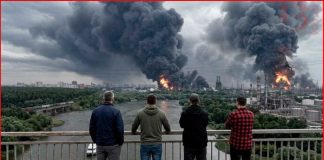
Millions of Americans in the Midwest are once again forced indoors as toxic smoke from Canadian wildfires blankets U.S. cities, prompting Republican lawmakers to demand immediate action from both Washington and Ottawa.
Story Snapshot
- For the third consecutive year, hazardous smoke from Canadian wildfires is suffocating Midwest and Northeast U.S. cities, impacting over 100 million Americans.
- Republican lawmakers are holding Canadian leaders accountable for policy failures and demanding urgent cross-border action to prevent future crises.
- Air quality alerts have become routine, with cities like Minneapolis and Chicago ranking among the world’s worst for pollution.
- Health, economic, and political pressures are mounting, with strained U.S.-Canada relations and growing demands for policy reform.
Hazardous Smoke Forces Americans Indoors—Again
A thick blanket of smoke from ongoing wildfires in Canada’s Saskatchewan and Manitoba provinces has pushed air quality in the U.S. Midwest to hazardous levels, triggering state and federal alerts that now affect more than 100 million Americans. Major cities including Minneapolis, Chicago, Milwaukee, and Detroit have seen their air quality indices spike into the “unhealthy” and “very unhealthy” ranges for days, according to the National Weather Service and the Environmental Protection Agency. These alerts, which have become disturbingly routine, are now a summer fixture for many Americans, who have watched their outdoor lives and businesses disrupted for the third year in a row. The Centers for Disease Control and Prevention warn that vulnerable groups—the elderly, children, and those with respiratory or cardiac conditions—face the greatest risks, with hospitals reporting spikes in related admissions.
The wildfires responsible for this crisis remain largely uncontained, with Canadian officials conceding that little relief is in sight. Since late July, prevailing wind patterns have carried dense smoke southward, blanketing states from Minnesota and Wisconsin to Illinois and Missouri. This recurring disaster is no longer viewed as an isolated event; rather, it marks a new normal, with severe health, social, and economic consequences for American families and businesses. As the weeks drag on, air quality alerts have become a grim part of daily life, and frustration is mounting at all levels of government.
Lawmakers Demand Cross-Border Accountability
Republican lawmakers are leading a chorus of demands for accountability and action, shifting the focus from environmental happenstance to policy failures across the border. They argue that repeated smoke invasions are a direct result of poor forest management and ineffective wildfire prevention policies in Canada. Congressional leaders are now pressing both U.S. and Canadian authorities to update decades-old air quality agreements and take immediate steps to mitigate future cross-border pollution. The legislative push includes calls for enhanced diplomatic engagement, stricter enforcement of environmental standards, and concrete measures from Ottawa to address what is increasingly seen as a preventable crisis.
For many in Congress, the issue goes beyond environmental management—it strikes at the heart of American sovereignty and the right of U.S. citizens to breathe clean air. While environmental and public health experts stress the global nature of climate change as a driving force, lawmakers remain steadfast in their insistence that action begins with holding Canada accountable for its policies. This stance resonates with conservative voters who are tired of international inaction and demand that American interests come first.
Economic and Health Fallout Intensifies
The short-term impacts of the smoke crisis are already severe, with widespread school and business closures, lost productivity, and mounting healthcare costs. Hospitals in affected regions have reported a surge in cases of asthma attacks, respiratory distress, and cardiac emergencies. Outdoor events are canceled, tourism is down, and local businesses—particularly those reliant on summer activity—are suffering significant losses. Experts warn that the long-term effects could include increased rates of chronic respiratory illness and a persistent decline in quality of life for millions.
State and local governments are struggling to manage the immediate fallout, while the insurance and environmental technology sectors brace for increased claims and demand. The ongoing crisis is also placing unprecedented strain on U.S.-Canada relations, with diplomatic tensions rising as both sides debate responsibility and next steps. Policy analysts suggest that unless both nations overhaul their approach to wildfire management and cross-border air quality enforcement, these costly disruptions will only worsen.
Mounting Pressure for Policy Reform and Bilateral Action
Three consecutive years of smoke-related emergencies have triggered a groundswell of public and political demand for reform. Lawmakers are preparing new legislation and diplomatic initiatives aimed at strengthening U.S. leverage in cross-border environmental disputes. Conservative advocates argue that defending American freedom and family values means demanding that our neighbors take responsibility for actions that directly harm U.S. citizens. The current administration has signaled a willingness to use every available tool—from renegotiating air quality agreements to applying diplomatic pressure—to ensure Canadian accountability.
Environmental scientists and public health experts continue to emphasize that climate change and drought are increasing wildfire risk on both sides of the border, but many believe the urgency of the moment requires practical, immediate solutions—not just long-term climate pledges. With the legislative and diplomatic process now in motion, Americans across the Midwest and Northeast are watching closely, demanding that their leaders prioritize their right to clean air and a safe home over international niceties and bureaucratic delay.
Sources:
US Census Bureau (2025 Air Quality and Wildfires)
TIME Magazine (Canadian Wildfires and US Air Quality, 2025)
ABC News (Canada Wildfire Smoke, 2025)
FOX Weather (Air Quality Alerts, 2025)