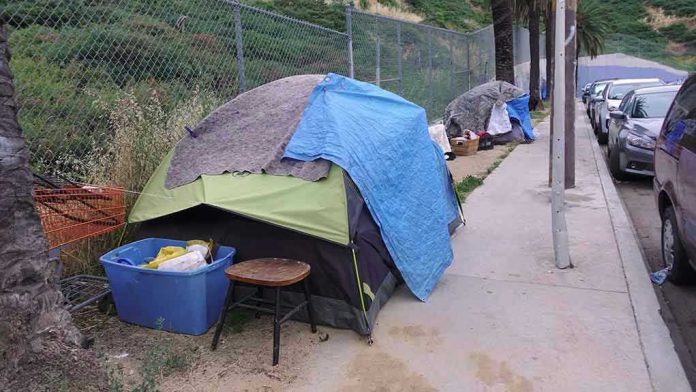
President Trump’s bold push to reopen mental institutions represents a direct challenge to decades of failed liberal policies that have left dangerous mentally ill individuals roaming America’s streets unchecked.
Story Highlights
- Trump reaffirms campaign promise to rebuild “insane asylums” for public safety and compassionate care
- White House executive order in July 2025 directs federal action on involuntary institutionalization
- Policy directly counters decades of liberal deinstitutionalization that fueled urban disorder
- ACLU and leftist advocacy groups mobilizing legal challenges against constitutional public safety measures
Trump Delivers on Mental Health Reform Promise
President Trump reinforced his commitment to reopening mental institutions during a September Daily Caller interview, stating bluntly that “You can’t have these people walking around. So dangerous, so dangerous.” This declaration follows through on campaign promises to address the mental health crisis plaguing American cities. The President’s approach directly challenges the failed liberal experiment of deinstitutionalization that began in the 1960s and has left countless mentally ill individuals without proper care or supervision.
The administration’s July 2025 executive order “Ending Crime and Disorder on America’s Streets” provides the federal framework for restoring civil commitment and institutionalization programs. This comprehensive directive empowers states to take decisive action against the homelessness and public safety crisis that has devastated cities under previous Democratic leadership. The order represents a fundamental shift away from the permissive policies that allowed dangerous individuals to remain on the streets.
Historical Context Reveals Liberal Policy Failures
The deinstitutionalization movement that began accelerating in the 1960s systematically dismantled America’s mental health infrastructure under the guise of civil rights reform. The 1963 Community Mental Health Act promised community-based alternatives but delivered inadequate resources and oversight. By the 1980s and 1990s, state hospitals closed en masse while promised community support systems never materialized, leaving vulnerable individuals abandoned and cities struggling with the consequences.
This liberal policy disaster created the current crisis where mentally ill homeless individuals pose threats to themselves and law-abiding citizens. Urban areas became dumping grounds for people who needed structured care, while Democratic leadership ignored the mounting evidence that their idealistic policies had failed catastrophically. The result has been decades of preventable tragedies and declining quality of life in American cities.
Constitutional Concerns Over Leftist Opposition
Predictably, the ACLU and other leftist organizations are preparing legal challenges against Trump’s common-sense approach to public safety. These groups prioritize abstract ideological positions over the constitutional duty to protect citizens from harm. Their opposition reveals the same misguided priorities that created this crisis, placing theoretical civil liberties above practical public safety and genuine compassion for the mentally ill.
The President’s policy represents a balanced approach that serves both public safety and humanitarian concerns. Rather than allowing vulnerable individuals to deteriorate on the streets while endangering others, institutionalization provides structured care and removes threats from communities. This approach respects the rights of law-abiding citizens to safe streets while ensuring proper treatment for those who cannot care for themselves. Opposition groups’ resistance demonstrates their continued commitment to failed policies over effective solutions.
Sources:
Ground News – Exclusive: Trump Open to Bringing Back Insane Asylums to Clean Up Streets
KMJ Now – Trump: Bring Back Insane Asylums, House Mentally Ill
White House – Presidential Action: Ending Crime and Disorder on America’s Streets