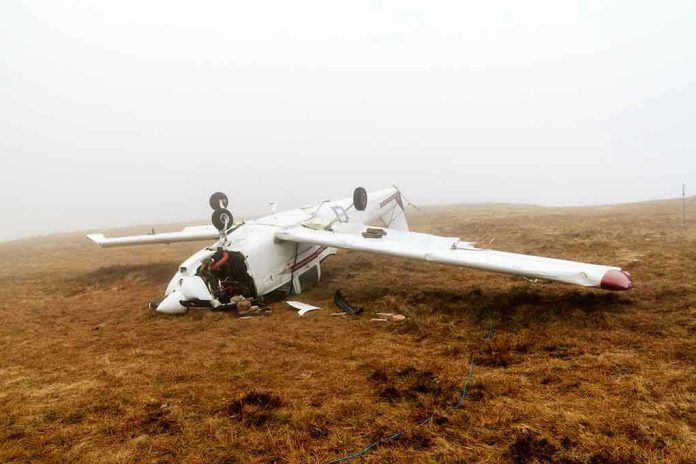
A horrifying tragedy unfolded as a small plane crashed onto a busy Massachusetts highway, raising urgent questions about public safety and government oversight at a time when Americans expect strong, common-sense leadership—not bureaucratic excuses.
Story Snapshot
- Two people killed and one injured when a private plane crashed onto Interstate 495 in Massachusetts during broad daylight.
- Immediate response from federal and state agencies highlights the dangers when oversight or preparedness falters.
- Preliminary investigation reveals no foul play or weather issues; safety concerns focus on pilot training and aircraft maintenance.
- The incident intensifies debate over government competence and the risks to everyday Americans from regulatory lapses.
Plane Crash on a Major Highway Exposes Public Safety Concerns
On October 12, 2025, a single-engine Piper PA-28 carrying two individuals departed Norwood Memorial Airport for a routine flight. Just 24 minutes later, the aircraft lost contact with air traffic control and, within minutes, plummeted onto Interstate 495 near Marlborough—a vital artery for Boston-area commuters. Both occupants died instantly, while a motorist on the ground suffered injuries. This rare but devastating event instantly threw thousands of drivers and first responders into chaos, spotlighting the vulnerabilities Americans face in the face of unpredictable disasters.
First responders from the Massachusetts State Police and local emergency services arrived within minutes, securing the scene and providing critical care to the injured motorist. Federal authorities, including the FAA and NTSB, were notified promptly, initiating a rigorous investigation. The rapid response was a testament to the professionalism of local agencies, but the fact that such a catastrophe could strike in the heart of a populous region left many questioning whether enough is being done to protect the public from preventable dangers.
Investigation and the Role of Regulatory Oversight
Preliminary findings released by the NTSB the next day confirmed no evidence of foul play or adverse weather. The pilot, a 58-year-old with a valid license and experience, had flown under clear conditions. Maintenance records for the aircraft were up-to-date, according to the FAA. Yet eyewitnesses reported hearing the engine sputter moments before impact, raising concerns about undetected mechanical issues or systemic gaps in oversight. The FAA and NTSB pledged to review pilot records, maintenance logs, and all relevant factors, but the investigation may take six to twelve months for a full report.
Historically, Massachusetts has seen few incidents of this nature, with most small plane crashes occurring in rural areas. The rarity of such crashes on major highways amplifies public anxiety and prompts scrutiny of general aviation regulations. While federal agencies maintain robust safety protocols, incidents like this reveal the potential consequences when even a single link in the safety chain fails—putting innocent Americans at risk in their daily lives.
Broader Implications for Public Safety and Government Accountability
The aftermath was felt far beyond the immediate scene. Traffic on I-495 was halted for eight hours, disrupting businesses, commuters, and emergency logistics. For the families of the victims and those injured, the emotional toll is incalculable. The broader public is left to wonder: are authorities doing enough to ensure that private aircraft are properly maintained, pilots are sufficiently trained, and flight paths avoid heavily populated areas when possible? These are not abstract policy questions—they strike at the heart of what Americans expect from their government: responsibility, transparency, and action that puts public safety above political squabbling or bureaucratic inertia.
Community leaders have called for increased scrutiny of small aircraft operations near urban centers. Experts point to the necessity of interagency coordination and emergency preparedness, while legal professionals highlight the importance of clear accountability in such tragedies. As the NTSB and FAA continue their investigation, the public deserves honest answers and decisive action—not more excuses or empty promises that leave communities exposed to preventable risks.
Restoring Trust and Focusing on Solutions
As the nation mourns the loss and reflects on the lessons from this tragedy, it is vital to reaffirm the principles of accountability and competence in government. Americans should not have to worry that regulatory failures or complacency will threaten their families’ safety on highways, in communities, or anywhere else. Events like this demand not just investigation, but real reforms that strengthen oversight, prioritize common-sense safety, and put the well-being of everyday citizens ahead of special interests or bureaucratic convenience. Only through vigilance, transparency, and strong leadership can public trust be restored—and the true promise of American safety and liberty be fulfilled.
Sources:
National Transportation Safety Board (NTSB) Preliminary Report, October 13, 2025.
Federal Aviation Administration (FAA) Aircraft Accident Database, 2025.
Massachusetts State Police Press Release, October 13, 2025.
Boston Globe, “Plane Crashes on I-495, Kills Two,” October 13, 2025.
WBZ-TV Boston, “Small Plane Crash on Massachusetts Highway,” October 12-13, 2025.
Aviation Safety Network, “General Aviation Accidents in Massachusetts,” 2010-2025.