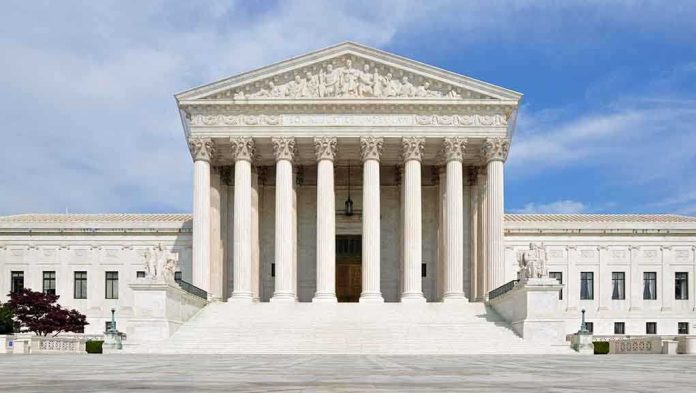
The Supreme Court’s recent move to let President Trump enforce biological sex markers on U.S. passports marks a major win for those demanding a return to common-sense documentation and a rejection of radical gender identity policies that frustrated Americans for years.
Story Snapshot
- The Supreme Court granted a stay, allowing Trump’s biological sex passport policy to take effect while litigation proceeds.
- Transgender, nonbinary, and intersex Americans must now list biological sex on new passports, reversing Obama-era rules.
- This decision is a procedural victory for the Trump administration and a blow to leftist advocacy groups seeking special gender recognition.
- The case highlights intense national debates over identity, executive power, and the restoration of traditional values in federal policy.
Supreme Court Sides with Trump Administration: Biological Sex Policy Enforced
On November 6, 2025, the U.S. Supreme Court granted the Trump administration’s request to stay a lower court’s injunction, immediately allowing the enforcement of a policy requiring all new or renewed passports to display an individual’s biological sex as listed on their birth certificate. This procedural decision does not end the case but puts the controversial policy into effect as legal challenges proceed. The policy reverses Obama-era rules, which allowed Americans to alter the gender marker on their passports with a doctor’s note, and re-centers the federal government’s documentation on objective, biological fact rather than self-declared identity.
This change is a direct response to the wave of “woke” policies from prior years, where progressive advocacy made it possible to change official documents based on gender identity, often without rigorous verification. The Trump administration and its supporters have long argued that such policies undermine document integrity, public safety, and the rule of law. By restoring the requirement for biological sex, the administration asserts its commitment to clear, consistent, and secure federal identification—a move that resonates with millions of Americans who have grown weary of the left’s social experiments at the expense of common sense and national cohesion.
Background: The Battle Over Federal Recognition of Gender
Passport gender marker policy has been a flashpoint in America’s broader culture war. Under President Obama, rules were relaxed in 2010 to allow gender changes on passports with a physician’s certification of gender transition. The Trump administration’s first term began to roll back these changes, and the second term has now moved decisively to require all federal identification to reflect biological sex. Left-leaning organizations, including the ACLU, and a coalition of transgender and nonbinary plaintiffs launched legal challenges against the new policy, arguing it strips individuals of privacy and safety, and erodes what they call “hard-won rights.” In contrast, the Trump administration maintains that federal documents must remain factual, uniform, and immune from ideological manipulation.
Legal experts point out that the Supreme Court’s action is procedural, not a final decision on the policy’s legality. However, the willingness of the Court to grant the stay indicates a strong deference to the executive branch’s authority over document standards and signals that, for now, the restoration of traditional, biologically rooted documentation is back on solid ground. As the case moves forward, it will test the limits of federal power, the role of the courts in social policymaking, and the durability of recent leftist gains in the culture war.
Immediate Impact and Conservative Response
The immediate enforcement of the biological sex policy has profound implications. Transgender, nonbinary, and intersex Americans must now use passports listing their birth sex, regardless of their current self-identification or transition status. Advocacy groups decry this as a “setback” and claim it places vulnerable individuals at risk. Yet, to many conservatives, this is a long-overdue correction after years of government overreach that eroded faith in basic institutions. The Trump administration frames the move as essential for document integrity and public trust, echoing the frustrations of citizens who watched identity politics trump reality in recent years. This battle is not just about passports but about reclaiming the principle that truth and clarity—not radical ideology—should guide federal policy.
In the short term, the policy creates new hurdles for those seeking to have government documents reflect their chosen identity. Longer-term, the outcome of this legal struggle could set precedent for how the federal government addresses controversial issues of self-identification vs. biological fact. The stakes are high: if the Trump administration prevails, it could mark a turning point in the fight to restore traditional values in government and roll back the excesses of the progressive agenda.
Broader Implications: Executive Power and American Values
The Supreme Court’s decision to stay the lower court injunction highlights a renewed willingness to defer to the elected executive branch on matters of national documentation and identification. This victory fits into a larger pattern of the Trump administration’s approach—asserting executive power to undo the policies of the prior administration and reinstate a government that respects the Constitution, individual liberties, and the foundational values of the nation. The case is far from over, but for now, the administration and its supporters can claim that the federal judiciary recognizes the legitimacy of restoring objectivity and security to government records. The debate continues, but the momentum has shifted toward the values and priorities of conservative Americans, who have demanded both sanity and sovereignty in public policy.
Supreme Court hands Trump victory on transgender passport policy change https://t.co/bnqhScBndm #FoxNews You libtards make NO FUCKING SENSE. One is either male or female at birth. Wannabe's don't count. Perhaps YOU forgot that; queer/sick bastard lovers.
— Dave York (@DYork83489) November 7, 2025
While litigation is ongoing, the broader message is clear: the Trump administration is delivering on its promise to reject radical leftist agendas, restore respect for facts, and put the interests of American citizens and families first. Many will watch closely as this legal and cultural battle continues, but for millions, this Supreme Court decision represents the return of common sense to Washington—and a decisive step toward reclaiming the country’s institutions from years of progressive overreach.
Sources:
Supreme Court Allows Trump Administration to Enforce Discriminatory Passport Policy
25A319 Trump v. Orr, Nov 6, 2025 (Supreme Court Official Opinion)