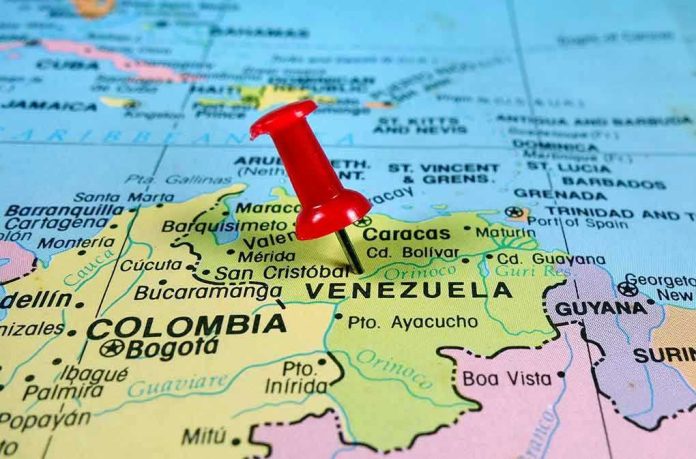
A bold military operation positions the U.S. as the overseer of Venezuela, sparking global reactions.
Story Highlights
- U.S. captures Venezuelan President Nicolás Maduro and assumes control.
- Trump justifies intervention as necessary for stability and counter-narcotics.
- International condemnation arises, citing a breach of sovereignty.
- Potential future actions suggested for Cuba, amplifying geopolitical tension.
U.S. Assumes Control Over Venezuela
In a startling move on January 3, 2026, President Donald Trump announced a U.S. military operation that led to the capture of Venezuelan President Nicolás Maduro and his wife. The operation, conducted under the cover of night, resulted in a declaration of American administrative control over Venezuela. Trump stated that the U.S. will govern the nation until a secure transition to a new government is achieved.
Trump’s announcement at a press conference highlighted the strategic reasons for the intervention, including countering narcotics trafficking and dismantling hostile military bases. The operation followed months of military buildup in the Caribbean, showcasing a significant shift in U.S. foreign policy.
Global Reactions and Ramifications
The international community reacted strongly to the U.S. intervention. Venezuela’s government condemned the action as a violation of the United Nations Charter, citing infringements on sovereignty. Russia and China, key geopolitical adversaries, expressed concerns over U.S. actions, warning of potential repercussions. Meanwhile, U.S. allies like the UK and Trinidad and Tobago distanced themselves from the operation.
Within Venezuela, the operation elicited mixed reactions. While some celebrated the potential for a political shift, others expressed outrage at the breach of national sovereignty. The U.S. maintains a military presence in the region, with Trump indicating readiness for further action if necessary.
Implications for Regional Stability
The U.S. control of Venezuela extends beyond immediate political implications, touching on significant economic interests. Venezuela’s vast oil and mineral resources now fall under U.S. administrative oversight, potentially altering the region’s economic landscape. The move sets a precedent for U.S. intervention in Latin America, with Trump and Secretary of State Marco Rubio hinting at similar operations in Cuba.
This unprecedented intervention raises questions about the future of international diplomacy and the balance of power within the Western Hemisphere. The Trump administration’s actions could redefine U.S. influence in Latin America, challenging traditional norms of sovereignty and international law.
Sources:
Trump: “We Are in Venezuela Now, and We Are Going to Stay”
Trump: “We Are Going to Run Venezuela Until Proper Transition Can Be Done”
Trump: Something Big Will Happen with Venezuela