A protest movement that claims “nonviolence” put federal officers in its crosshairs in downtown Los Angeles—right as Americans are already split over a new overseas war.
Quick Take
- Los Angeles’ March 28 “No Kings” demonstrations included a large daytime rally and a later nighttime clash near the downtown Federal Detention Center.
- LAPD declared an unlawful assembly after crowds pushed fences and threw objects; officers used tear gas and made arrests, with reports ranging from “dozens” to roughly 75.
- Caltrans installed metal swing gates at some 101 Freeway ramps ahead of the protest to prevent repeat freeway shutdowns seen in earlier events.
- Organizers promoted the day as historic and nonviolent, but local reporting documented “agitators” and a clear breakdown into street disorder after the main rally.
From City Hall Rally to Federal-Building Flashpoint
Los Angeles’ “No Kings” protest on March 28 unfolded in two distinct phases that matter for anyone trying to separate lawful dissent from street intimidation. Local reporting described thousands gathering during the afternoon hours near City Hall and Grand Park. After that permitted-style event tapered off, a separate confrontation formed outside the Federal Detention Center downtown, where federal law enforcement presence and immigration enforcement ties have made the area a repeated target.
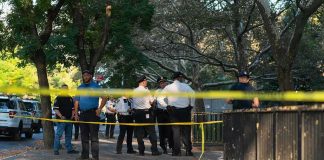
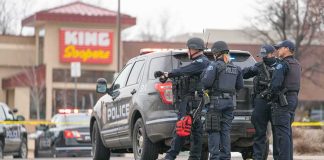
ABC7 reported that the situation deteriorated outside the federal facility after crowds pressed against barriers and attempted to pull down fencing. Officers responded with dispersal orders and crowd-control measures, including tear gas, while arrest teams moved in. Video and eyewitness coverage focused on objects being thrown—described as rocks, bottles, and chunks of concrete—turning what many attendees may have viewed as protest into a direct physical threat to officers and nearby civilians.
What Police and Transportation Officials Prepared For
Officials did not treat this as a routine weekend march. The Los Angeles Times reported that Caltrans installed metal swing gates on select 101 Freeway ramps in downtown Los Angeles ahead of the planned gatherings. The stated purpose was to prevent demonstrators from spilling onto high-speed lanes and shutting down traffic, a tactic that has become common in large political demonstrations. Caltrans framed the barriers as a public-safety measure meant to reduce crashes and chaos.
That preparatory move also reflects a broader pattern: when protest organizers promise peaceful conduct but cannot prevent splinter groups from turning events into freeway blockades or assaults on law enforcement, state and local agencies increasingly harden infrastructure. For residents, that means detours, slower emergency response, and higher overtime costs. For civil libertarians, it raises the question of whether repeated disorder invites heavier security that narrows legitimate public space.
Arrests, “Agitators,” and the Limits of the “Nonviolent” Claim
Reports from the night described arrests ranging from “dozens” in confirmed coverage to approximately 75 in circulating summaries of the incident. ABC7 described a scene with tactical posture, blocked streets, and multiple detainees. Organizers and supporters promoted the broader “No Kings” actions as nonviolent and historic in scale nationwide. But the Los Angeles footage and arrest activity show a familiar problem: if a movement cannot police its own perimeter, the public experiences the worst actors as the message.
The most inflammatory allegation circulating online involved an anti-ICE death-threat slogan allegedly graffitied on the federal building. The detailed local reporting reviewed here strongly corroborates clashes, fence-pulling, and projectiles thrown at officers. However, the exact wording of the graffiti and the precise arrest total were not uniformly confirmed across the mainstream local sources provided. Readers should separate what is on-camera and reported by local outlets from what may be amplified by partisan social media.
Why This Hits a Nerve in 2026: Immigration, War Fatigue, and Trust
The Wikipedia overview of “No Kings” describes the protests as opposition to Trump administration policies, with a focus that includes immigration enforcement and other flashpoints in 2026. That context matters because the country is simultaneously living through major foreign-policy strain, including war with Iran, while many voters—especially older, working- and middle-class conservatives—are exhausted by decades of open-ended conflicts, high energy costs, and a government that seems perpetually ready to spend abroad while families feel pinched at home.
That’s where the politics get complicated for the MAGA coalition. Some Trump supporters want stronger immigration enforcement and back federal officers facing street violence. Others, angered by “forever war” dynamics and skeptical of Washington’s foreign entanglements, are less willing to rally behind any narrative that demands unity without answers. When a domestic protest turns violent at a federal facility, it fuels calls for crackdowns—yet it also deepens distrust in institutions that too often fail to draw clear constitutional lines.
INSANE! No Kings Protester Graffitis "KILL YOUR LOCAL ICE AGENT" on Federal Building in Los Angeles as Rioters Clashed with Federal Agents and Threw Concrete Blocks – 75 Arrested (VIDEO) | The Gateway Pundit | by Jordan Conradson https://t.co/H0qAyhqYu9
— Brian Baker (@Brian_D_Baker) March 29, 2026
For conservatives focused on law-and-order and constitutional rights, the immediate takeaways are practical: peaceful assembly is protected, attacks on officers are not, and claims of “nonviolence” should be judged by conduct, not slogans. For everyone else trying to stay grounded, the key is resisting narrative traps—whether it’s pretending the violence didn’t happen, or pretending every protester shared the intent of the handful who threw concrete and forced a police response.
Sources:
https://www.latimes.com/california/story/2026-03-27/no-kings-freeway-gates
https://www.foxla.com/news/no-kings-day-protest-march-28-california-locations
https://en.wikipedia.org/wiki/2026_No_Kings_protests