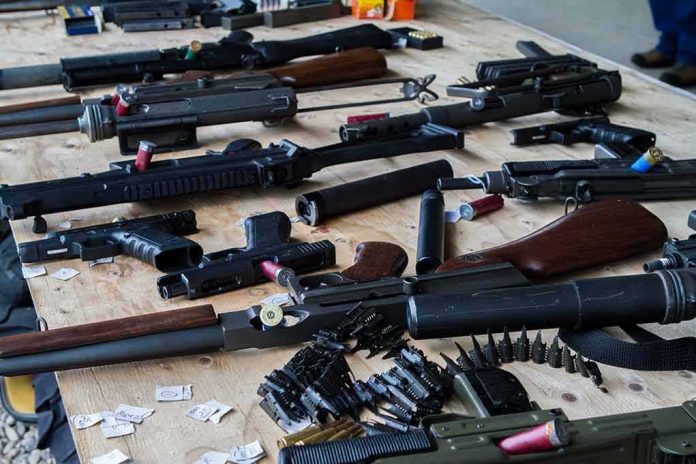
A Nevada man admitted he helped funnel 140 American-bought guns to Mexican drug groups for profit, confirming a years-long pipeline that crossed the border with ease.
Story Snapshot
- Luis Alberto Osorio pleaded guilty to trafficking 140 firearms to groups tied to Mexican drug operations.
- The plea also covers money laundering and harboring unauthorized workers, with sentencing set for February 11, 2027.
- The scheme ran from April 2020 to September 2025 and used straw purchases to acquire guns, magazines, and ammo.
- Federal data show straw purchasing is a leading trafficking method in thousands of cases nationwide.
Plea Admits Border-Bound Gun Pipeline
The Department of Justice said Luis Alberto Osorio, of northern Nevada, pleaded guilty to trafficking 140 firearms, straw purchasing, harboring certain aliens, and conspiring to launder money. Prosecutors said he and co-defendants bought guns, magazines, and ammunition in the United States for people tied to drug trafficking groups in Mexico, then sold them in Mexico for profit. The court set sentencing for February 11, 2027. The Justice Department said the statutory maximum across the counts totals 70 years.
According to the government, the conduct ran from April 1, 2020, through September 17, 2025, and used straw buyers to mask the true purchasers. Straw purchasing happens when someone buys a gun on behalf of someone else who wants to avoid the required checks and records. The U.S. Attorney’s Office in Nevada echoed the plea details in a same-day social media post that highlighted the 140 firearms figure and the cartel-linked channel.
How Straw Purchasing Fuels Cartels
The Bureau of Alcohol, Tobacco, Firearms and Explosives reported that straw purchasing is one of the two most common trafficking channels. From 2017 to 2021, straw purchasing showed up in about 39.5 percent of trafficking investigations. That bucket covered 3,305 investigations and involved 37,749 trafficked firearms overall. This case follows that pattern: guns bought in the United States by stand-ins, then moved for resale to criminal buyers across the border.
Federal analysis also shows the scale of gun flows. The Bureau of Alcohol, Tobacco, Firearms and Explosives says it examined 9,708 closed firearms trafficking investigations from 2017 to 2021, a period that documented widespread use of unlicensed dealing and straw purchasing to move guns into illegal markets. This context helps explain why prosecutors frame a plea like Osorio’s as a warning to networks that exploit weak points in the retail system.
Broader Stakes for Security and Rule of Law
This case ties street-level buying in the United States to violence and drug profits in Mexico. When traffickers exploit paperwork and paid stand-ins, guns slip past basic checks and end up with the most dangerous buyers. Communities on both sides of the border pay the price. The facts in the plea also touch domestic concerns at once: illegal labor practices, financial laundering, and cross-border crime that undercuts local jobs, wages, and safety.
𝐍𝐄𝐕𝐀𝐃𝐀 𝐌𝐀𝐍 𝐏𝐋𝐄𝐀𝐃𝐒 𝐆𝐔𝐈𝐋𝐓𝐘 𝐓𝐎 𝐓𝐑𝐀𝐅𝐅𝐈𝐂𝐊𝐈𝐍𝐆 𝟏𝟒𝟎 𝐆𝐔𝐍𝐒 — 𝐈𝐍𝐂𝐋𝐔𝐃𝐈𝐍𝐆 .𝟓𝟎-𝐂𝐀𝐋 𝐒𝐍𝐈𝐏𝐄𝐑 𝐑𝐈𝐅𝐋𝐄𝐒 — 𝐓𝐎 𝐌𝐄𝐗𝐈𝐂𝐀𝐍 𝐂𝐀𝐑𝐓𝐄𝐋𝐒
Elko, Nevada resident 𝐋𝐮𝐢𝐬 𝐀𝐥𝐛𝐞𝐫𝐭𝐨 𝐎𝐬𝐨𝐫𝐢𝐨 pleaded guilty to straw… pic.twitter.com/IsDpnIMdNQ
— M.A. Rothman (@MichaelARothman) August 16, 2026
Both conservatives and liberals see a core problem here: institutions are slow to close obvious gaps. People worry that powerful players, whether cartels or corrupt middlemen, bend rules while officials talk tough. A clear case with named counts and a set sentencing date offers accountability. But lasting progress will require steady enforcement, faster tracing, and better screening to choke off straw buys before guns leave the country.
Sources:
townhall.com, justice.gov, x.com