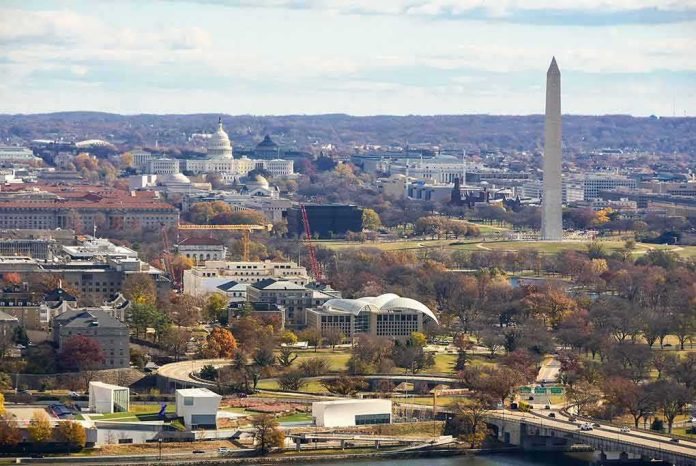
President Trump says the 250-foot Triumphal Arch will double as a “top grade Military Complex,” even as federal records on the project still read like a monument, not a base.
Story Highlights
- Trump says the arch will serve national security as a “Military Complex.”
- Federal reviews advanced a 250-foot monument at Memorial Circle near Arlington.
- Park Service found “adverse effects” on landmark views yet outlined mitigations.
- Veterans sued, arguing the project lacks new congressional approval.
What The President Announced About The Arch
President Trump said the planned Triumphal Arch in the nation’s capital will also function as a “top grade Military Complex” to serve national security needs. Reports describe this as a shift from a pure monument to a dual-use site, made “at the request of the U.S. military,” according to coverage of his remarks. The statements reignited a debate already running hot over the arch’s size, location, and purpose near Arlington National Cemetery.
Separate reporting quotes Trump describing the complex as capable of hosting security functions, while still presenting as a ceremonial arch. Those claims arrive as design filings and reviews on record have focused on commemorative goals and site planning rather than on military requirements. The distance between the rhetoric and the paperwork is driving new questions from both supporters and critics about what the structure is, and who it is for.
What Federal Planning Documents Actually Show
Interior Department and National Park Service materials describe a 250-foot freestanding arch at Memorial Circle, with a review path under preservation law. The National Capital Planning Commission gave preliminary approval to site and building plans, advancing the project through the capital’s design gatekeepers. The record includes mitigation steps, not a denial, which signals momentum. None of these documents, as reported so far, lay out a military mission or base operations at the site.
Planning coverage also details an aggressive build timeline. Reports say excavation could begin quickly and construction could run two to three years with long daily shifts. That pace, combined with only preliminary approvals so far, has fueled warnings about process. Critics argue early ground work can create a “done deal” feel before all questions are answered. Supporters say speed shows resolve and reduces cost risks from delay.
Why Preservation Officials And Veterans Are Alarmed
The National Park Service found the arch would cause “adverse effects” on dozens of historic resources and key sightlines that link Arlington National Cemetery, Arlington House, the Arlington Memorial Bridge, and the Lincoln Memorial. The agency still outlined ways to document and reduce harm, such as protection plans and interpretation, while keeping the location. That balance angers many who see sacred ground and symbolic views as non-negotiable parts of the civic landscape.
Veterans and an architectural historian sued earlier this year. They argue the project lacks needed congressional authorization and would block important views. Their case frames the fight as both legal and moral. They point to the solemn meaning of the area and warn that a towering structure will overshadow spaces where families mourn and citizens reflect. The administration rejects that view and cites the review process and design merits.
The Clash Between Monumental Vision And Security Claims
Public filings and renderings emphasize commemoration, heritage, and grand design. The newer “military complex” label has not been matched, in the public record, by named defense agencies, security assessments, or hardened facility plans. That gap matters because security infrastructure usually comes with strict requirements, from force protection to controlled access, which are not evident in the available planning documents described in reports to date.
🚨 JUST IN: President Trump reveals at the request of the military and for national security, he is converting the Triumphal Arch in DC to a MILITARY complex/arch that will “house, store, and have the rapid ability to use large numbers of drones, plus Snipers” 🔥
“On both the…
— Theusadailynews (@thescottbessent) September 20, 2026
For many readers, this story lands on a sore point that crosses party lines: government that moves fast on prestige projects while core needs feel stuck. Supporters hear pride, heritage, and strength. Opponents hear vanity, overreach, and disrespect for hallowed ground. Both sides ask who is being heard and who benefits. Clear answers will likely require formal defense endorsements, transparent funding details, and a firm, lawful basis for any true dual-use role.
Sources:
yahoo.com, cnbc.com, spectrumlocalnews.com, washingtonian.com, politico.com, cnn.com, thehill.com, wtop.com