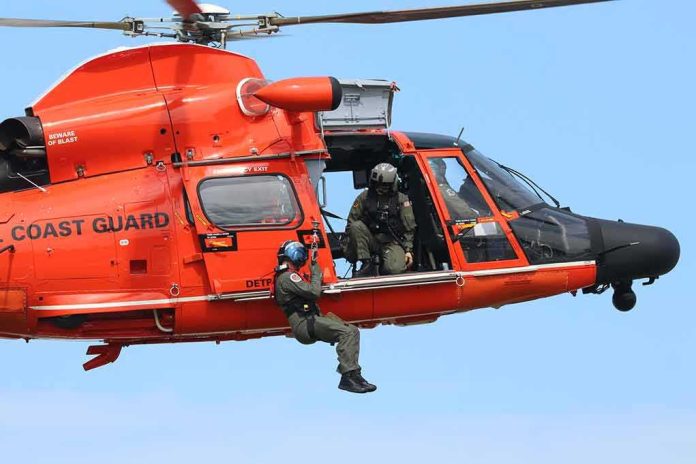
Early Saturday, the U.S. Coast Guard launched air and surface crews after a Boston-bound Gulfstream jet with six people aboard vanished off Nantucket, sharpening fears about safety and transparency in a system too often slow to answer basic questions.
Story Snapshot
- Coast Guard crews are searching off Nantucket for a missing Gulfstream G100 from Bermuda to Boston.
- Officials say the Federal Aviation Administration (FAA) lost contact early Saturday; six people were on board.
- Search efforts include air and surface assets; the outcome is not yet known.
- Maritime search and rescue falls to the Coast Guard under national protocols.
What Authorities Confirmed So Far
The Coast Guard said it launched a search off Nantucket after the Federal Aviation Administration reported losing contact with a Gulfstream G100 early Saturday. News outlets described the flight as traveling from Bermuda to Boston with six people on board. Reports placed search operations in waters near Nantucket, a common corridor for trans-Atlantic and island routes into New England. Officials have not released a tail number, operator name, or passenger identities. Authorities have not reported debris, survivors, or a location for the jet.
Federal aviation guidance explains how cases like this move fast from air traffic concerns to rescue action. When an aircraft is missing or overdue, the National Search and Rescue Plan triggers alerts and coordination. Over ocean and coastal waters, the U.S. Coast Guard leads the search and rescue mission. The Federal Aviation Administration shares flight and contact details with rescue coordinators, who then deploy aircraft and cutters as conditions allow. This split role often makes the Coast Guard the first public voice.
Where The Search Is Focused And Why
Coast Guard updates described the search area as off the coast of Nantucket, which sits along the final leg into Boston from Bermuda. That focus aligns with standard practice: responders start near the last known position and the planned route. They factor in winds, sea state, and time since last contact to map likely drift and fuel limits. Aircrews run grid patterns to spot debris fields or life rafts. Surface crews check currents and report any findings in real time to command centers.
Weather, daylight, and water temperature shape survival odds and search tactics. Strong winds or high seas can scatter debris, making visual searches harder. Cool North Atlantic waters reduce time for safe exposure. These realities push responders to launch quickly and keep assets on scene as long as safe. The Coast Guard’s Boston-area Rescue Coordination Center manages those assets and syncs information with the Federal Aviation Administration and local partners as the mission evolves.
Why Details Can Be Scarce In The First Hours
Search and rescue operations start with speed, not press-ready detail. Early reports often include only the aircraft type, route, and number of people on board. That is by design. The Federal Aviation Administration’s alert system feeds the Coast Guard just enough to launch. Confirming a tail number, operator, or cargo can take time, and public release can wait until families are notified. Meanwhile, media repeat the basic facts so families and the public know help is moving.
"Coast Guard Launches Urgent Search Off Nantucket After Boston-Bound Medical Jet Carrying 6 People Vanishes"
➡️ Emergency rescue crews with the U.S. Coast Guard have launched an urgent search operation over open water off the coast of Nantucket after a twin-engine medical jet…
— BreakinNewz (@BreakinNewz01) October 3, 2026
This pattern can frustrate people across the political spectrum who want straight answers. Many feel the system talks around details while regular folks are left to guess. In reality, the Coast Guard often carries the burden alone in maritime cases, while the Federal Aviation Administration stays in a support role. That can make the Coast Guard the only source for hours. Clear, steady updates help, but they arrive while crews are flying search grids, not sitting at keyboards.
What To Watch Next
Watch for the Coast Guard to announce any debris, beacon pings, or sightings tied to the last known route. Look for the Federal Aviation Administration to share a brief incident summary later. If crews find wreckage, the National Transportation Safety Board would open an investigation. If they find survivors, medical evacuation and statements will follow. Until then, the facts remain simple and firm: a Gulfstream G100 from Bermuda to Boston went missing, and search teams are working off Nantucket.
Sources:
facebook.com, wcvb.com, nbcboston.com, nbcnews.com, faa.gov, pinkpillbox.com