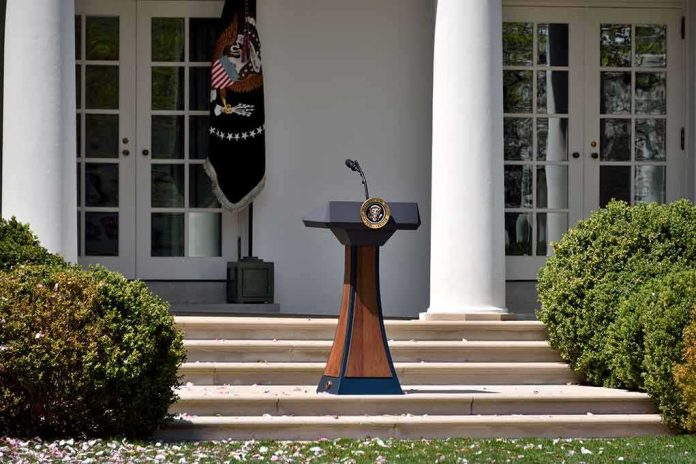
President Trump said he “would love to run again,” putting a real third-term debate on the front burner.
Story Snapshot
- Trump signaled interest in a 2028 run while noting strict constitutional language.
- Supporters point to the word “elected” in the Twenty-Second Amendment as a possible opening.
- A House proposal seeks to allow up to three presidential elections, but it faces steep hurdles.
- Legal scholars largely dispute any third-term path, setting up courtroom and political fights.
Trump’s Stated Intent Meets Tight Constitutional Text
Media coverage reported that President Trump said he would “love to run again if I had the chance,” while also calling the constitutional language “very exacting.” That shows clear interest but not a formal plan. The Twenty-Second Amendment says no person shall be elected president more than twice. Trump’s words keep the door cracked, but they also admit a legal wall stands in the way right now.
Naming the limit matters. The amendment uses the word “elected,” not “serve.” Some allies argue that the text leaves room for service by succession rather than election. Others float a vice-presidential path tied to that reading. Trump has said “there are methods,” and agreed a vice-presidential scenario is one of them, while adding there could be others. Reporting notes courts have not settled those exact questions in a final ruling.
The Legislative Route: A Straightforward but Steep Climb
One clean method sits in plain sight: change the Constitution. Representative Andy Ogles introduced a House joint resolution in January 2025 to allow a president to be elected up to three times. That path honors the rule of law and lets voters, states, and Congress decide. But amendments require two-thirds of both chambers and three-fourths of the states. Backers must build a serious coalition before 2028 to make it real.
Conservatives who want limited government and clear rules may see the amendment path as the honest route. It avoids games with succession and forces a national debate. Supporters can argue voters deserve the choice after years of fights over borders, energy, and runaway spending. Critics will say term limits protect liberty. The amendment process would test both claims in the open, with states holding the final say under Article Five.
Legal Pushback and the “Elected” Versus “Serve” Debate
Legal scholars widely argue that a third term is blocked. They read the Twenty-Second Amendment as a firm two-election cap that covers practical attempts to get back into office. Analysts also warn that the Twelfth Amendment may bar a two-term president from being vice president if he is “constitutionally ineligible” to be president. That view challenges any vice-presidential workaround and sets up fast court fights if a campaign moves ahead.
Some commentary entertains the narrow “elected” wording and the idea of later service through succession. Even then, experts caution that challenges would hit immediately in multiple states. That would trigger different rulings and confusion. A courtroom brawl would not help public trust. Trump’s own note that “the law is very strong” against a third term suggests any path will be hard and will need either new text or a decisive court ruling to stand.
What Comes Next for Voters Who Want a Say
Two tracks remain. First, a formal amendment campaign can rally states and make the question simple: should Americans be allowed to elect a proven president a third time during a crisis era? That route respects federalism and lets families, workers, gun owners, and small-business owners decide. Second, a legal test could clarify how the Twenty-Second and Twelfth Amendments work together, but it risks a flood of suits and media spin before a clear answer arrives.
President Trump says he is fighting communism with everything he has and would love to run again in 2028.
If he gets the chance, would you vote for Donald Trump for a third term? pic.twitter.com/9xANZjIDA0
— Godly Nation (@GodlyNations) November 1, 2026
Conservatives should watch three signals. Track support for the Ogles amendment in Congress and the states. Watch whether party officials or secretaries of state issue written guidance on 2028 ballot access. And if litigation starts, read the actual filings, not the headlines. The stakes involve rule of law, voter choice, and avoiding backroom tricks. If change comes, it should be honest, transparent, and rooted in the Constitution—not in loopholes that invite more chaos.
Sources:
mediaite.com, nationalsecurityjournal.org, the-independent.com