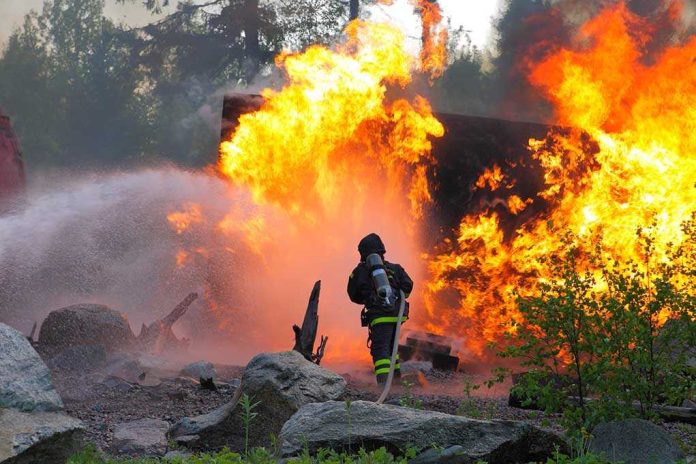
A convicted felon is now accused of sparking Spokane’s biggest wildfire as thousands struggle to rebuild and wonder how this was allowed to happen.
Story Snapshot
- Investigators arrested 37-year-old Aaron F. Farinacci on suspicion of first-degree arson in the Old Trails Fire.
- The Old Trails Fire is the largest of three Spokane-area wildfires that destroyed hundreds of buildings and drove tens of thousands from their homes.
- Citizen tips and early reports of “suspicious behavior” near dry grass helped detectives link Farinacci to the fire’s origin.
- The case raises hard questions about public safety, stressed fire systems, and a justice system many Americans feel no longer protects them.
Arrest in Spokane’s Old Trails Fire
Authorities in Spokane County, Washington say they have arrested 37-year-old Aaron F. Farinacci on suspicion of first-degree arson in connection with the Old Trails Fire, the largest of three blazes burning around the city. The Spokane County Sheriff’s Office reports that major crimes detectives and state fire investigators developed probable cause, secured an arrest warrant, and took Farinacci into custody at his Spokane home without incident on Monday afternoon. He is being held on one million dollars bail and is expected to appear in court this week.
Spokane County officials say the Old Trails Fire was first reported around midday on August 1 near North Old Trails Road and West Euclid Road, just north of Airway Heights. A community member told deputies they saw a man bending down in the grass who looked nervous; later, they saw smoke coming from the same spot. Deputies initially contacted Farinacci during evacuations but released him due to a lack of evidence at the time. Investigators later say they tied him back to that origin area and sought a warrant.
What Investigators Say Happened
Detectives now say they believe the Old Trails Fire was intentionally started using matches or a lighter. When they arrested Farinacci, officials report he had waterproof matches and a butane lighter on him. The Spokane County Sheriff, John Nowels, said tips from citizens, combined with information from local police and deputies who handled evacuations, proved “extremely valuable” in building the case. Investigators emphasize that the investigation is still active, and more charges could follow as they continue to review evidence and fire patterns.
Officials describe a tense sequence that captures how stretched public safety has become. First responders rushed to move families out of harm’s way while trying to track a man witnesses linked to the ignition point. They found Farinacci about four miles from where the fire started but say there was not yet enough evidence to hold him. Only after major crimes detectives and fire investigators took a deeper look did they connect his movements, the witness report, and the physical items he carried to an intentional fire start. That gap between first contact and later arrest worries many who already feel the system acts too slowly.
Damage, Prior Record, and Public Frustration
The Old Trails Fire has destroyed more than seven hundred buildings and forced over sixty thousand people to evacuate in and around Spokane, Washington’s second-largest city. For families who lost homes, small businesses, or farms, the arrest offers some relief but no quick fix. Many see yet another example of government reacting after the damage is done, not preventing it in the first place. These scenes add to a long list of disasters where people on both the left and the right feel basic protection has failed.
National and local reports note that Farinacci is a convicted felon with a prior manslaughter conviction for killing his father in Arizona in 2010. That history fuels anger among citizens who ask why someone with a violent record was free to roam near dry brush during peak fire danger. To them, this case is not only about one suspect; it shows a justice system that often seems to cycle dangerous people in and out while ordinary families carry the risk and the loss. That frustration crosses party lines as communities watch hundreds of buildings burn.
Why This Case Feels Bigger Than One Fire
As firefighters battle multiple blazes and residents sift through ashes, the Old Trails case taps into wider fears about how fragile daily life has become. People see crowded prisons and overloaded courts, yet still watch convicted felons walk near tinder-dry fields with matches in their pockets. They see big promises about climate, land management, and “resilience,” but they also see neighborhoods evacuated with little warning and local crews stretched to the breaking point. For many, this looks like a deep state that talks about safety but cannot deliver it.
Wildfire arson cases often depend on witness reports, scene evidence, and expert fire analysis instead of clear video or a confession. That makes careful work by trained investigators vital, but it also means trust in institutions matters. In Spokane, officials are urging patience as the case moves to court, reminding the public that an arrest is not yet a conviction. Still, both conservatives and liberals who already doubt the federal and state systems will watch closely. They want proof that when someone is accused of lighting a match that destroys hundreds of buildings, the law will act swiftly, fairly, and firmly — not only in this case but in the next one too.
Sources:
apnews.com, spokanecounty.gov, khq.com, abc15.com, youtube.com, clickorlando.com, facebook.com