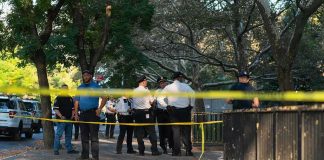
When law enforcement warns an armed fugitive is moving through rugged terrain, the operative public-safety truth is simple: uncertainty expands the danger zone. Iowa Hill, a small community in the canyons of Placer County, learned that in stark terms as deputies confronted a suspect who rammed a patrol vehicle, opened fire on officers and aircraft, and fled into the woods—prompting an immediate “lock your doors and remain inside” directive that did exactly what such guidance is designed to do: buy time and reduce casualties while police contain a mobile threat.
At a Glance
- Deputies identified Derek Spencer, 44, as armed and dangerous in Iowa Hill; a vehicle-ramming and gunfire preceded a manhunt in steep, forested terrain.
- Residents were told to lock doors and stay inside, a standard, temporary shelter-in-place action to minimize civilian exposure amid an uncertain line of fire.
- The suspect was linked to pointing a gun at people earlier that day, escalating risk and justifying rapid perimeter and aviation support.
- Deputies later encountered Spencer again; he fired and was killed in a shootout, underscoring why officials treated the situation as an active, moving threat.
What Happened: From Confrontation to Community Lockdown
According to multiple contemporaneous reports based on Placer County Sheriff’s Office statements, deputies located 44-year-old Derek Spencer in the Iowa Hill area, where he rammed a patrol vehicle, fled into the surrounding woods, and fired at law enforcement on the ground and at law-enforcement helicopters overhead. Authorities labeled him armed and dangerous and instructed residents to lock their doors and remain indoors while deputies and air units searched the canyon country around the town. This wasn’t the first violent act attributed to Spencer that day; earlier accounts said he had pointed a firearm at people, an allegation that raised the stakes for any subsequent encounter and accelerated the deployment of a containment posture.
The terrain mattered. Iowa Hill sits amid steep, forested drainages where sightlines are short, escape routes are plentiful, and a suspect with a rifle can shift positions before ground units close a perimeter. Aviation support increases awareness, but it also becomes a potential target; reports that shots were directed toward helicopters highlight why agencies quickly widen standoff distances and warn civilians to get inside and stay put. The shelter-in-place directive functioned exactly as intended in this context: reduce the number of people exposed to a fluid and potentially lethal line of fire while officers worked to locate a moving gunman.
Why “Shelter in Place” Was the Right Tool
Shelter-in-place is a temporary protective action—stay indoors, secure entry points, and wait for an official all-clear—that public-safety agencies use when immediate risk is uncertain and mobility increases exposure. Federal guidance is explicit: remain in place until law enforcement says the danger has passed, lock and block doors, and minimize visibility and noise if violence is a factor. In fast-moving manhunts, the calculus shifts from a static crime scene to a dynamic hazard: a suspect may move unpredictably, the line of fire can change with terrain, and responders must balance pursuit with protecting bystanders. That combination is exactly why the language tends toward clarity and breadth—“lock your doors and remain inside”—rather than granular caveats that would slow compliance or create confusion.
This is not a finding about guilt; it’s a protective directive. In practice, it reduces the number of unaccounted-for civilians on porches, roads, or trails who might unwittingly intersect with a pursuit corridor. For rural communities like Iowa Hill, where a single ridge can separate officers and residents by a few hundred yards and zero visibility, the directive is especially effective: fewer people exposed, fewer variables for deputies to mitigate, and a cleaner perimeter for aviation and ground units to coordinate search patterns.
Escalation and Resolution in Difficult Terrain
Reports indicate that after initial contact and flight, deputies later encountered Spencer in rough country; he again fired on officers from cover—described as behind a berm—and was shot and killed during the exchange. The detail is not incidental. Firing from a covered position in broken terrain is exactly the sort of tactic that complicates a fast arrest, extends operations across hours, and justifies sustained protective measures for nearby residents. It also explains the sequencing many residents recognize from similar incidents: initial warning, aviation orbiting overhead, ground units methodically clearing drainages, and then a final concentrated response when the suspect is pinned and re-engages.
Accounts also tie Spencer to felony allegations that preceded the Iowa Hill encounter—including pointing a firearm at people earlier the same day—which, taken together with the ramming and gunfire at deputies, situates the manhunt within the standard rubric for an armed and active threat. Later coverage connected him to a broader crime spree under investigation, but from a public-safety perspective, the operational decisions in Iowa Hill are sufficiently explained by the immediate facts of ramming a patrol vehicle, firing at officers, and retreating into terrain that favored further ambush.
How Agencies Manage Risk When the Suspect Is Moving
When officers confront an armed suspect in open country, they manage three variables at once: time, terrain, and uncertainty. Time favors the suspect if he remains mobile; terrain can be leveraged for concealment and fire positions; uncertainty is the multiplier that endangers bystanders. Commanders therefore convert uncertainty into structure. They widen a cordon; they issue clear, simple instructions to residents; they bring in aviation to restore visibility; and they slow the tempo just enough to avoid pushing units into blind corners that create crossfire risk.
Public messaging reflects that logic. Clear imperatives—stay inside, lock doors, await further instruction—encourage uniform behavior across a community and reduce chaotic movement that could be misread by air crews or ground teams. This isn’t mere optics; research and federal guidance emphasize that prescriptive, plain-language alerts improve compliance and safety during rapidly evolving threats. In Iowa Hill, the instruction did not depend on perfect information about the suspect’s location; it acknowledged the opposite—that location was fluid—and therefore minimized exposure while deputies restored control.
🚨 BREAKING: Small California town of Iowa Hill on lockdown after gunman rams and fires on deputies before fleeing into the woods.
Placer County Sheriff's deputies searching for 44-year-old Derek Spencer, considered armed and dangerous.
NO SUSPECT IN CUSTODY. MANHUNT ONGOING.… pic.twitter.com/xEvjx4lqO3
— EzeNews (@EzeBets) September 21, 2026
What It Means for Residents and Responders
For residents, the takeaway is pragmatic. When law enforcement issues a shelter-in-place directive tied to an armed, at-large suspect, treat it as a short-duration safety protocol: secure your home, limit your visibility, monitor official channels, and wait. The measure is temporary by design and lifts when the risk collapses—either because the suspect is contained or neutralized, or because the search area has been cleared. The Iowa Hill sequence—initial violence, a period of indoor sheltering, aviation and ground pursuit, final contact—follows a well-understood pattern for rural manhunts.
For agencies, Iowa Hill is a case study in why disciplined messaging and terrain-informed tactics matter. The combination of aviation, methodical ground clearing, and unambiguous public guidance aligns with accepted best practices for containing an armed suspect in complex topography. The subsequent shootout that ended the threat underscores the wisdom of treating the moment between first contact and final containment as a period of heightened, not hypothetical, risk. That is precisely what “lock your doors and remain inside” communicates—and why it worked here.
Sources:
nypost.com, kcra.com, yubanet.com, inedc.com, 2news.com