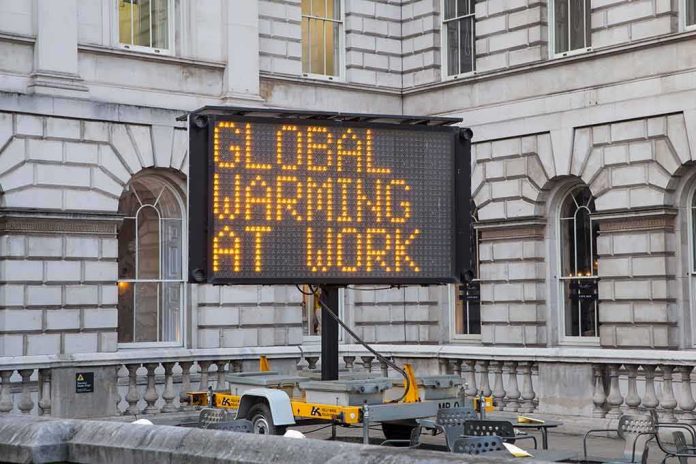
Two-thirds of all Americans faced dangerous heat alerts heading into the July 4th holiday weekend, with heat index values forecast to hit 115 degrees Fahrenheit across the eastern United States.
Story Snapshot
- The National Weather Service (NWS) issued Extreme Heat Warnings, Watches, and Advisories covering parts of 31 states on June 29, 2026.
- About 90 million Americans were under active extreme heat alerts, with up to 230 million potentially exposed to dangerous conditions.
- Heat index values were forecast to reach 115 degrees Fahrenheit, with overnight lows staying in the 70s — giving the body almost no chance to recover.
- Central Pennsylvania counties faced an Extreme Heat Warning running straight through July 4th, with feels-like temperatures near 110 degrees.
A Heat Dome Locks In Over the Eastern Two-Thirds of the Country
A heat dome — a dome of high pressure that traps hot air like a lid on a pot — settled over the central and eastern United States in the final days of June 2026. The NWS described it plainly: “dangerous to record-setting heat will expand across the eastern two-thirds” of the country. That is not a weather agency being dramatic. That is a measured, official warning backed by forecast data showing heat index values well above 100 degrees for days on end.
The heat index is what the air actually feels like when you factor in humidity. A thermometer might read 98 degrees, but with thick, soupy air, your body experiences something closer to 110 or 115. NWS forecaster Bryan Putnam said it directly: heat indices will go “well into the 100s” because of the humidity combination. That is the number that matters for your health — not the raw temperature on a weather app.
Why Nighttime Offers Almost No Relief
Here is the part most people miss. Your body needs nighttime to recover from daytime heat stress. When overnight lows only drop into the 70s Fahrenheit, that recovery never fully happens. You go to sleep warm, you wake up already behind. Day after day of that cycle is when heat stops being uncomfortable and starts being deadly. The 1995 Chicago heat wave killed roughly 739 people in five days — and nighttime temperatures that stayed dangerously high was a key factor in that disaster.
This event was forecast to behave the same way. Temperatures in central Pennsylvania, for example, were expected to hit 100 degrees or more, feeling closer to 110 with humidity, with that pattern holding through July 4th. Five counties — Adams, Dauphin, Lancaster, Lebanon, and York — were placed under an Extreme Heat Warning that ran through the holiday. Planning a cookout in those counties meant planning around a genuine health threat, not just an inconvenient hot day.
The Scale of This Alert Is Historically Large
Alerts covering parts of 31 states at once is not routine. For context, the NWS only issues an Excessive Heat Warning when daytime heat index values are expected to hit 105 degrees or higher and nighttime lows stay at 75 or above for at least 48 hours straight. When those thresholds trigger warnings across three-quarters of the continental United States simultaneously, the event is genuinely large-scale — not a regional hot spell dressed up in alarming language.
"a prolonged, dangerous heat wave will intensify across the central and eastern U.S. this week. The extreme heat will continue through Friday ….."
"Extremely Dangerous Heat Expected. High temperatures of 95-105 degrees combined with high humidity will result in heat indices of… https://t.co/xvy6nPt53I
— Dan Tsubouchi (@Energy_Tidbits) July 2, 2026
Heat is already the deadliest weather hazard in the United States in an average year, killing around 400 people annually. Events like this one push that number far higher. The 1980 heat wave killed more than 1,250 Americans. These are not abstract statistics. They are a reliable preview of what happens when dangerous heat persists, people underestimate it, and vulnerable populations — the elderly, the very young, outdoor workers — run out of options.
What the Heat Actually Does to a Human Body
Your body cools itself by sweating. Sweat evaporates, and that process pulls heat away from your skin. Humid air slows that evaporation down dramatically. Penn State researchers found that humans cannot safely endure temperatures and humidities as high as previously assumed — the body’s cooling system simply cannot keep up. When the air is already saturated with moisture, sweat stops working efficiently, and your core temperature climbs. That is when heat exhaustion tips into heat stroke, and heat stroke can kill in hours.
The practical advice from the NWS is straightforward and worth taking seriously: stay indoors, drink water, skip the alcohol, wear light clothing, and find air conditioning if you do not have it at home. Many communities set up cooling centers for exactly this reason. Common sense and a little planning are genuinely life-saving tools during a heat event of this size — and the data from past events makes clear that the people who dismiss the warnings are the ones who end up in emergency rooms.
Sources:
insiderpaper.com, usatoday.com, washingtontimes.com, npr.org, reddit.com, climatecheck.com, sydney.edu.au