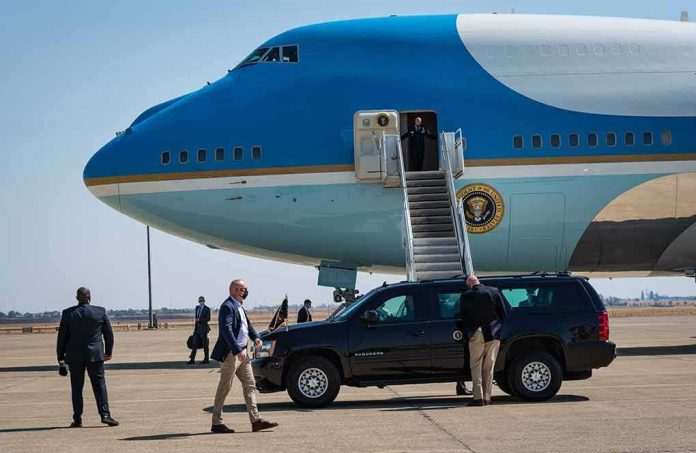
A U.S. Coast Guard jet flying Homeland Security Secretary Markwayne Mullin declared an in-flight emergency after losing its right engine, then landed safely at Reagan National.
Story Snapshot
- The crew reported a right engine failure and requested an immediate landing at Reagan National.
- The Coast Guard-operated Gulfstream jet diverted and landed safely around 1:35 p.m., with no injuries.
- Fourteen people were aboard; Mullin praised the pilots for a calm, professional single-engine landing.
- Conflicting reports describe the engine issue as a failure, and in some coverage, as involving fire.
Emergency Declared And Safe Landing In Washington
Air traffic control audio and multiple outlets report the flight crew declared an emergency after the jet’s right engine failed while inbound to Washington, D.C.. Controllers cleared the aircraft to land at Ronald Reagan Washington National Airport, where it arrived safely on Wednesday afternoon, around 1:35 p.m. local time. Officials and reporters described an orderly approach and landing. No injuries were reported among those on board. The basic sequence is not in dispute across major national outlets.
Reporters identified the aircraft as a United States Coast Guard-operated Gulfstream jet, commonly used for executive transport; some accounts label it a C-37A, which is the military version of the Gulfstream V. The pilot coordinated with controllers and shared fuel remaining while setting up for the approach, which is standard in single-engine operations on twin-engine jets. The immediate focus was to land at the nearest suitable airport, a long-standing aviation safety practice.
Who Was On Board And What Officials Said
Outlets consistently reported that fourteen people were on board, including Secretary Mullin. After landing, Mullin publicly praised the United States Coast Guard pilots, saying they made the single-engine landing feel routine and showed “straight professionalism”. Reuters likewise emphasized that the jet diverted and landed safely after the right engine failed, underscoring that there were no reported injuries to passengers or crew. ABC News also cited the same headcount aboard and confirmed a safe outcome.
Some reports differ on how to describe the mechanical event. Reuters and others say the engine failed, while another outlet says the engine caught fire after failing. That detail matters for technical classification, but it does not change the core facts already established: the crew shut down the affected engine, declared an emergency, and landed safely at Reagan National. Major reporting does not cite an official mishap report at this stage.
Why The Outcome Matters For Public Safety
Single-engine landings on twin-engine transport jets are trained for and expected when a failure occurs. The key test is whether the crew keeps control, contains the failure, and lands promptly. In this case, the crew did that, and all aboard walked away. The Federal Aviation Administration’s guidance and National Transportation Safety Board practice call for prompt notification and documentation when certain serious engine incidents occur, especially uncontained failures.
🇺🇸DHS flew its own secretary in an OBSOLETE 22-year-old jet that should've been replaced last year, and the engine failed mid-flight.
A U.S Coast Guard jet carrying Homeland Security Sec Markwayne Mullin declared an emergency after flying out from Atlanta. The plane was diverted… pic.twitter.com/wPNs91hyA6
— Mario Nawfal (@MarioNawfal) September 3, 2026
When a Cabinet official is aboard, the public often sees a quick “safe landing” headline and little else. That can leave questions about maintenance, airframe age, and procedures. Here, the reports vary on the aircraft’s exact description and whether fire was present, which are details an official review could clarify. For now, the big picture is straightforward: trained crews, established checklists, and rapid coordination prevented a bad day from becoming a tragedy.
Sources:
youtube.com, politico.com, washingtonpost.com, reuters.com, x.com, ntsb.gov, faa.gov