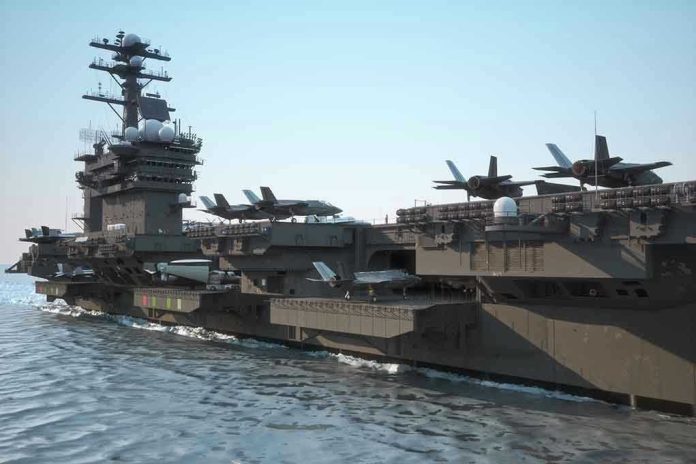
A former Iranian Revolutionary Guard commander just threatened to sink American warships patrolling one of the world’s most critical oil chokepoints, raising the stakes in a volatile standoff that could send global energy markets into chaos.
Story Snapshot
- Mohsen Rezaei, top military adviser to Iran’s Supreme Leader, warned Iran will sink US ships attempting to “police” the Strait of Hormuz
- The threat comes as US Navy destroyers successfully transit the strait amid Iranian claims they turned back vessels with 30-minute attack warnings
- The Strait of Hormuz handles roughly 20 percent of global oil shipments through a 21-mile-wide waterway
- President Trump dismisses Iranian threats as empty bluster after recent strikes decimated Iranian naval and air force capabilities
- Rezaei opposes extending the fragile ceasefire and claims Iranian missile launchers are locked onto US warships
A Former Commander Makes His Move
Mohsen Rezaei knows how to make noise. The former Islamic Revolutionary Guard Corps commander, appointed just last month as the Supreme Leader’s top military adviser, appeared on Iranian state television April 15 with a message calculated to unsettle Washington. He declared that American ships would sink under Iran’s “first missiles” if the United States continued attempts to control the Strait of Hormuz. Rezaei even mockingly welcomed a potential US invasion to retrieve hostages, framing Iranian defiance as strength rather than desperation in the face of overwhelming American military superiority.
The timing matters. Rezaei’s appointment came during a period when recent US and Israeli strikes had gutted Iranian naval assets and air defenses. President Trump has publicly claimed Iran is “losing big,” pointing to destroyed mine-laying vessels and degraded capabilities. Yet here stands Rezaei, chest puffed, insisting Iranian launchers have American warships in their crosshairs. The rhetoric serves a purpose beyond mere bluster. Iran needs to project strength precisely when its conventional military power has been significantly diminished, relying instead on asymmetric threats and psychological warfare.
The Narrow Gateway That Powers the World
The Strait of Hormuz represents far more than a geographic feature on maritime charts. This 21-mile-wide bottleneck between Iran and Oman serves as the jugular vein for global energy markets, channeling approximately one-fifth of the world’s oil supply from Persian Gulf producers to international buyers. Since the 1979 Iranian Revolution, this chokepoint has remained a flashpoint. Iran claims territorial authority over the waterway while the United States asserts freedom of navigation rights, a fundamental disagreement that has spawned decades of friction, harassment incidents, tanker seizures, and military posturing.
Previous confrontations in 2019 and 2020 demonstrated Iran’s willingness to escalate tensions through tanker attacks and speedboat harassments. The current situation amplifies those historical precedents with higher stakes. The fragile ceasefire following recent military strikes creates an environment where miscalculation could trigger broader conflict. Global shipping companies now advise vessels to disable automatic identification systems when transiting the region, an indicator of genuine security concerns rather than mere political theater.
Competing Versions of Reality
The narrative split between Washington and Tehran reveals how information warfare complements military posturing. US Navy officials confirm their guided-missile destroyers have transited the strait successfully without incident, maintaining routine freedom-of-navigation operations. Iranian state media tells a contradictory story, claiming they issued 30-minute attack warnings that forced American vessels to retreat. US officials and reporting from Axios dispute this Iranian version entirely, creating a he-said-she-said scenario where neither side can afford to appear weak before domestic audiences.
Rezaei’s specific language carries weight beyond typical diplomatic friction. His statement that American ships “can definitely be exposed to our missiles” and will be “sunk by our first missiles” represents an explicit threat of military action. Yet actions diverge from words. Despite the inflammatory rhetoric, no actual attacks have occurred. The gap between Iranian threats and Iranian capabilities post-strike appears significant, though asymmetric warfare tactics including mines, swarm boat attacks, and proxy forces remain viable options for a regime determined to demonstrate relevance.
The Domino Effect on Global Energy
Strategic analysts at the Center for Strategic and International Studies warn that Iran may pursue a multi-chokepoint strategy, potentially directing Houthi proxies toward the Bab al-Mandeb strait to compound pressure on global shipping. This approach would simultaneously threaten the Strait of Hormuz and the southern Red Sea entrance, forcing commercial vessels into impossible choices and driving energy costs skyward. Saudi Arabia’s pipeline bypass routes offer limited relief, unable to absorb the volume that typically flows through these maritime corridors.
https://www.foxnews.com/world/gate-tears-risk-iran-threatens-major-new-global-chokepoint-us-moves-hormuz
The economic implications extend beyond oil prices. Insurance rates for vessels transiting disputed waters have already climbed. Supply chain disruptions ripple through economies dependent on Middle Eastern energy exports. Political pressure mounts on the Trump administration to either de-escalate through diplomacy or demonstrate military resolve through action. Gulf state oil exporters watch nervously, their economies vulnerable to any sustained conflict that closes shipping lanes or triggers retaliatory strikes on petroleum infrastructure.
Strength Versus Desperation
Rezaei’s threats reveal more about Iranian weakness than strength when examined through a practical military lens. A nation confident in its conventional capabilities typically demonstrates power through action rather than announcement. The pattern of dramatic threats followed by inaction suggests Iran seeks to deter American enforcement of maritime control without triggering a confrontation it would likely lose decisively. The regime needs to satisfy domestic hardliners demanding resistance while avoiding suicide by superpower. The result is rhetorical escalation that sounds alarming but remains carefully calibrated to stop short of actual engagement.
President Trump’s dismissive response treats Iranian warnings as predictable posturing from a weakened adversary. His administration points to degraded Iranian military assets as evidence that Tehran lacks the means to execute threats effectively. Yet complacency carries its own risks. Cornered regimes sometimes lash out irrationally, and asymmetric tactics can inflict damage disproportionate to conventional military balance. The fragile ceasefire that Rezaei opposes extending represents a tenuous barrier against escalation that could rapidly spiral beyond any party’s control once the first missile flies or the first ship sinks in the strait’s confined waters.
Sources:
Iran military adviser threatens to sink US ships if Washington ‘polices’ Hormuz
Iran threatens US ships in Strait of Hormuz amid naval operations
Gate of tears risk: Iran threatens major new global chokepoint as US moves in Hormuz