U.S. border officers say a canine team helped uncover about 450 pounds of cocaine hidden under a truck’s floor at a U.S.–Canada crossing, an alleged $6 million haul that shows smugglers still exploit commercial trade lanes.
Story Snapshot
- Customs officers found 174 packages of cocaine in a modified trailer floor at a northern border bridge.
- A canine alert led to a secondary inspection and the discovery, officials said.
- The load weighed about 450 pounds and was valued at an estimated $6 million.
- Homeland Security Investigations in Buffalo is leading the follow-up probe.
What Officers Reported Finding at the Bridge
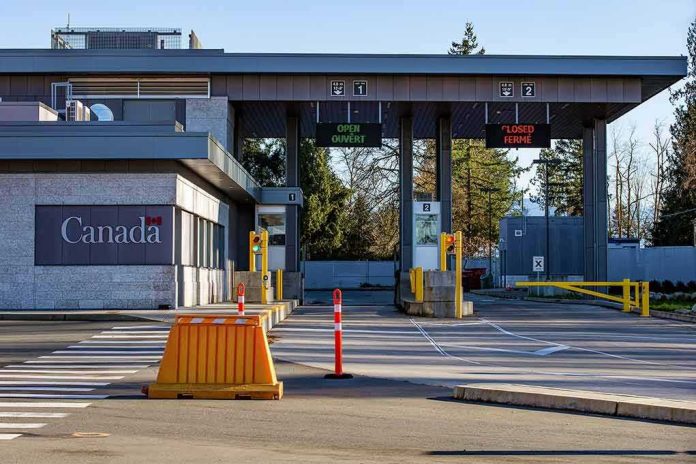
Customs and Border Protection officers reported the cocaine seizure after stopping a commercial tractor-trailer at the Lewiston-Queenston Bridge last week. Officers encountered a 21-year-old Canadian driver during the inspection on September 22, according to local coverage citing agency statements. Officers said they noticed changes to the trailer’s floor. That prompted a canine screening and a referral to secondary inspection. There, officers found 174 vacuum-sealed packages that field-tested positive for cocaine.
Fox News Digital, citing the agency, reported the haul at about 450 pounds, with an estimated street value of $6 million. That estimate reflects standard valuation practice reported by media, though the detailed price basis was not provided in the coverage. Officials said Homeland Security Investigations in Buffalo took the case for further review, a routine step when a large shipment is seized at a land port of entry. Authorities did not release the driver’s name in the cited reports.
How the Inspection Unfolded and Why It Matters
Border officers said a physical check first revealed that the floor had been altered, a known concealment method in smuggling cases. The canine alert then supported a deeper search in secondary, where officers accessed the hidden space and recovered the packages. This sequence—irregularity spotted, canine deployed, secondary search completed—tracks with standard port enforcement methods. It also reflects the balance officers try to strike each day: clear lawful trade fast while flagging small signs that point to big risks.
Large drug loads move through the northern border in both directions, but government threat reports have long highlighted a northbound flow of cocaine into Canada through United States corridors and commercial routes. That backdrop explains why inspectors put extra focus on commercial trucks. Smugglers look for scale and cover. Freight provides both. Intercepts like this one show that detection still hinges on alert officers, trained dogs, and targeted secondary checks, not just big machines or databases.
The Bigger Picture: Trade, Trafficking, and Public Costs
The United States and Canada share one of the world’s busiest trade relationships, and most cargo is lawful. But even a few compromised loads can feed crime, addiction, and violence far from the border. Federal strategies across administrations describe cocaine as a main threat on this frontier, often routed from South America through the United States and into Canada via land ports. That pattern raises costs for taxpayers, strains local police, and erodes trust in systems built to move goods, not contraband.
This hero K-9 named Star sniffed out $6 million worth of cocaine hidden under the floor of a tractor-trailer.
CBP says officers along the U.S.-Canada border discovered roughly 450 pounds of cocaine worth an estimated $6 million after noticing modifications during an inspection… pic.twitter.com/W44zDQXPs9
— Fox News (@FoxNews) September 30, 2026
People on the right and the left often agree on this point: government must guard borders without choking trade or wasting money. This case highlights that challenge in plain terms. Officers caught a large load, which is a win. Yet the method—floor modifications in a commercial trailer—shows that traffickers keep testing weak points. Effective oversight means steady staffing, canine teams that can work every shift, and clear metrics for what success looks like. Voters want results they can see.
Sources:
facebook.com, foxnews.com, nextnewsnetwork.com, singlinkbot.com