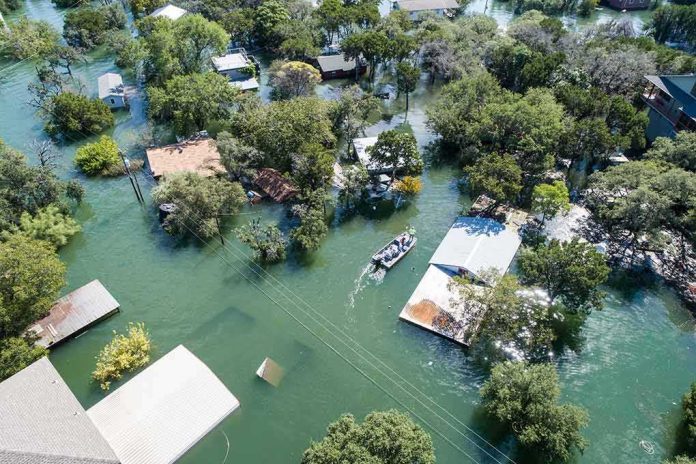
Federal help is on the way after deadly floods and storms killed multiple people and forced mass rescues across Indiana.
Story Snapshot
- Officials confirmed at least five storm-related deaths across several Indiana counties.
- President Trump approved emergency aid after Governor Braun’s statewide disaster declaration.
- Indianapolis crews carried out dozens of water rescues as rivers set new records.
- Evacuations, shelters, and travel limits were ordered to protect people and infrastructure.
Confirmed Deaths And Where The Storms Hit Hardest
Indiana emergency leaders said at least five people died as floods and high winds hit different parts of the state this week. Officials linked deaths to flooding in central Indiana and wind damage in the northwest. Reporting cited fatalities in Jennings, Lake, Porter, and LaPorte counties, with two in Delaware County. Some investigations were still active, so totals could change. Authorities stressed that people should avoid floodwaters and downed lines as cleanup continues.
Heavy rain fell in bands that stalled over neighborhoods and river basins. Local outlets reported 10 to 12 inches in some areas, which pushed rivers past long-standing records. In Noblesville, the White River reached 23.9 feet, breaking a 1913 mark. Fast rises trapped drivers and homeowners. Crews waded and boated through streets that became channels. Officials warned that even shallow, moving water could knock adults off their feet and sweep cars away.
Mass Rescues, Evacuations, And Local Orders
Indianapolis firefighters reported 51 water rescues during the peak response, evacuating 95 people and 45 pets. Another update logged about 50 rescues in a single day, with boats working near 78th Street and Keystone Avenue. City leaders urged people in flood-prone areas to leave before water rose again. “If you are in an area that is vulnerable, please leave now,” Indianapolis Mayor Joe Hogsett said. Noblesville’s mayor warned drivers to obey closures and stay out of the water.
Local governments opened shelters and moved people out of danger. Sites included the Washington Township Adult Center, the Broad Ripple Park Family Center, and the Hamilton County Fairgrounds. Operators shut the White River North Water Treatment Plant to protect key systems from damage. Counties issued travel advisories to keep roads clear for ambulances, utility crews, and rescue boats. Noblesville officials said about 170 residents and six animals left voluntarily as water neared homes. Power outages hit pockets across the region.
Statewide Disaster Step And Federal Aid Approval
Governor Mike Braun declared a statewide disaster emergency and activated the Indiana National Guard. He asked Washington for immediate help to support evacuations, debris work, and sheltering. President Trump approved an emergency declaration that makes federal assistance available. The Federal Emergency Management Agency (FEMA) said the action allows aid to support lifesaving work and protect property and health. These steps unlock staff, supplies, and money to back local and state efforts.
Under the Robert T. Stafford Act, a presidential emergency declaration can be made when federal help is needed to save lives and reduce threats. FEMA explains that emergency declarations support urgent services, while detailed damage counts follow later. This process matches what happened in Indiana. Officials moved quickly to secure resources while rescue numbers and damage reports were still changing in real time. That speed aims to cut risk before the next round of rain arrives.
Why Counts Shift And How To Stay Safe
Early numbers in flood disasters often change as agencies confirm events and merge reports. Reuters and other outlets reflected that shift as crews worked across multiple counties. Research on flood safety shows many deaths happen in vehicles during fast water events. A national study found that most flash flood fatalities involve cars, which is why officials keep saying, “Turn around, don’t drown”. Drivers should avoid any flooded road, even when water looks shallow or the surface seems intact.
🚨 TWO MAJOR DISASTERS HITTING AMERICA RIGHT NOW
Indiana: Devastating floods have killed at least 5 people — including a 4-year-old boy — with several still missing. Nearly a foot of rain in places. Entire neighborhoods underwater along the White River. Rescue crews still… pic.twitter.com/JEcDa3v8ap
— Gunther Eagleman™ (@GuntherEagleman) August 16, 2026
People across the political spectrum share one hope here: a system that works when it counts. First responders answered hundreds of calls. Local leaders opened shelters and warned at-risk neighborhoods. State officials secured federal help fast. Still, families will ask hard questions about drainage, alerts, and aging infrastructure. Those answers will matter in the weeks ahead. For now, heed closures, check on neighbors, and follow local guidance as rivers fall and repairs begin.
Sources:
aljazeera.com, indystar.com, reuters.com, cfjctoday.com, nbcnews.com, ipm.org, wfyi.org, abcnews.com, x.com