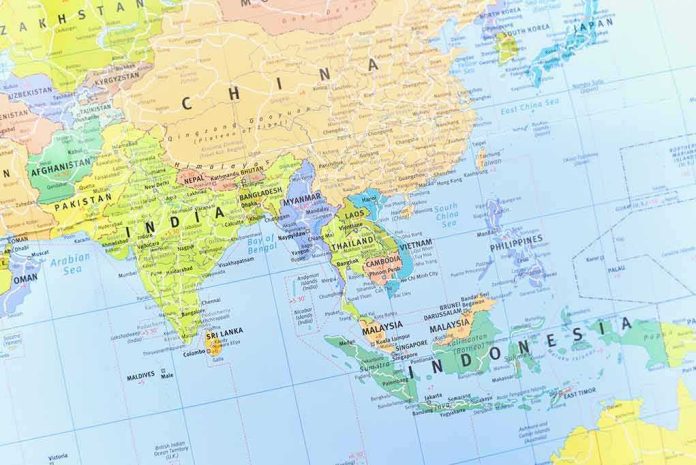
A Chinese coast guard ship blasted a Philippine government vessel with a water cannon at point‑blank range near a disputed reef, in the latest show of Beijing’s growing aggression at sea.
Story Snapshot
- Chinese coast guard used a powerful water cannon on a Philippine ship near a disputed South China Sea reef, coming within about seven meters.
- Philippine officials say the vessel was on a lawful mission to support local fishermen inside their exclusive economic zone.
- China claims the Philippine boats “intruded” in its waters and says its actions were proper law enforcement.
- The clash fits a pattern of repeated Chinese water‑cannon attacks and dangerous maneuvers against Philippine vessels in recent years.
Philippine Ship Blasted At Close Range Near Scarborough Shoal
Philippine officials report that a Chinese coast guard vessel hit the government ship BRP Datu Paduhinog with a powerful water cannon blast near a disputed reef in the South China Sea. The coast guard says the Chinese ship closed to roughly seven meters, then fired across the vessel, describing the maneuver as “reckless” and dangerous. The incident occurred near Scarborough Shoal, also known locally as Bajo de Masinloc, a rich fishing ground long claimed by both Manila and Beijing.
The Philippine Coast Guard states that the BRP Datu Paduhinog was part of a mission tied to aid and fuel support for Filipino fishermen operating near the shoal. Officials say the ship was working inside what the Philippines considers its exclusive economic zone, roughly 130 to 200 kilometers off Luzon, the country’s main island. Video and images released by Philippine authorities and shared by global media show Chinese vessels using water cannons against Philippine ships in similar recent encounters.
China Defends Action As Law Enforcement, Calls Philippines An Intruder
China’s coast guard claims that Philippine vessels “intruded into” what it calls Chinese waters near Scarborough Shoal and says its crews acted in line with the law to block them. Chinese statements describe their measures, including water cannons, as “standard, professional and lawful” efforts to expel foreign ships from the area. Beijing continues to assert sovereignty over Scarborough Shoal and surrounding waters, rejecting the Philippines’ position and a 2016 international ruling that undercut China’s sweeping South China Sea claims.
Chinese officials and state media often accuse Philippine ships of making “dangerous approaches” or even deliberately colliding with Chinese vessels during these clashes. Manila firmly denies those charges and instead points to Chinese maneuvers that bring large coast guard cutters and escorting ships within a few meters of much smaller Philippine boats. Philippine officers argue that such behavior violates basic collision‑prevention rules at sea and puts unarmed crews at clear risk, even when no one is hurt.
Pattern Of Repeated Water‑Cannon Confrontations In Disputed Waters
The latest water‑cannon strike is not an isolated case; it fits a wider pattern of confrontations around Scarborough Shoal and other contested reefs in the South China Sea. In past missions, Philippine patrol and fisheries vessels near Scarborough have been blasted multiple times, rammed, or boxed in by several Chinese coast guard ships working together. Some of those earlier attacks damaged bridges and equipment and left at least one Filipino crew member injured by shattered glass.
A China Coast Guard (CCG) vessel fired a water cannon at a Philippine #fisheries vessel delivering fuel subsidies to Filipino fishermen at Panatag (Scarborough) Shoal on Thursday, the Philippine Coast Guard (PCG) said. https://t.co/lUgzrX3le3
— UBC Oceans (also found at ubcoceans.bsky.social) (@UBCoceans) July 24, 2026
Beyond Scarborough, Philippine supply missions to Second Thomas Shoal have also faced Chinese water‑cannon fire that disabled engines and forced boats to turn back. Philippine military and coast guard leaders repeatedly describe the Chinese use of high‑pressure water cannons as “dangerous,” “illegal,” and a threat to the lives of sailors and fishermen. They argue that these actions violate international law at sea and go against the spirit of basic humanitarian norms in busy waters where small civilian craft depend on safe passage.
Why This Matters For American Allies And Sea Freedom
Scarborough Shoal sits in a key area of the South China Sea, a region where heavy shipping traffic and vital energy routes pass close to the coasts of U.S. partners like the Philippines. The shoal lies well within the Philippines’ exclusive economic zone as defined by modern sea law, even though China still claims control and has pushed to label it a national nature reserve. Every new clash over fishing boats or small patrol ships raises the risk that a misstep could harm crews and drag treaty allies deeper into a crisis.
For American readers, especially those who care about strong borders and national sovereignty, the fight over this reef highlights a simple issue: does a smaller ally have the right to use and defend its own waters without being bullied by a larger power. Repeated water‑cannon attacks, rammings, and “near‑miss” maneuvers look less like routine policing and more like pressure aimed at forcing the Philippines to back down from its lawful claims. That matters for freedom of navigation, fair trade routes, and for every partner who stands with the United States in checking aggressive moves by rival regimes.
Sources:
insiderpaper.com, straitstimes.com, apnews.com, aljazeera.com, reuters.com, bbc.com, cnn.com, en.wikipedia.org, youtube.com, france24.com, cbsnews.com, washingtonpost.com, scmp.com, srnnews.com