When America’s top diplomat says a war with China would be “catastrophic” yet insists we “have to have a relationship,” it puts the country’s deepest fears about power, profit, and peace on full display.
Story Snapshot
- Secretary of State Marco Rubio says the United States “has to have a relationship” with China and that avoiding dialogue would be “reckless and irresponsible.”
- Rubio warns any military or economic conflict between the United States and China could be “catastrophic” for both nations and the world.
- His comments come after talks with Chinese Foreign Minister Wang Yi and ahead of President Trump’s planned meeting with President Xi Jinping.
- Rubio argues Washington must balance tough competition with steady communication to keep crises over trade, Taiwan, and security from spiraling.
Rubio’s “Delicate Balancing Act” With China
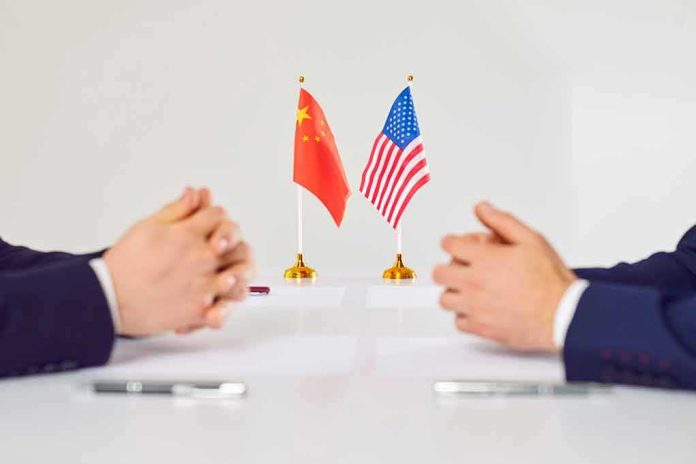
Secretary of State Marco Rubio is trying to sell Americans on a simple but uneasy idea: the United States must talk with China even while treating it as a rival. Speaking to reporters in Manila, Rubio called the United States and China “the two most powerful countries in the world” and said it would be “reckless and irresponsible” for them not to maintain a working relationship. He warned that any clash between the two nuclear powers, whether military or economic, could have “dramatic” and even “catastrophic” global effects.
Rubio repeated a message he has been giving for months: communication with Beijing is not optional, it is a duty. In a translated February briefing, he said two nuclear-armed economic giants “must be able to talk, communicate and interact” and that cutting off dialogue would be “reckless” and “dangerous.” In a television interview, he added that it is “irresponsible” for the United States not to have direct talks with China, even while recognizing that the countries are sometimes “competitors” and sometimes “direct adversaries.”
Talks With Wang Yi And The Coming Trump–Xi Summit
Rubio’s latest remarks came on the sidelines of a meeting of Southeast Asian foreign ministers, where he met Chinese Foreign Minister Wang Yi to discuss how to manage rising tensions. The two talked ahead of a planned visit by Chinese President Xi Jinping to the United States for talks with President Trump, a summit Rubio said both sides still expect to happen. Rubio described the meeting with Wang as “constructive” and said they discussed ways to build “strategic stability” and prepare “high-level exchanges” between the leaders.
Chinese officials also stressed their own red lines. According to Beijing’s summary of the meeting, Wang Yi told Rubio that the United States must respect China’s “core interests,” manage differences, and address China’s “legitimate concerns.” The Chinese foreign ministry described the talks as “pragmatic, positive and constructive” and said both sides agreed to prepare for the “next stage” of top-level engagement. Rubio said the goal is for Xi’s visit to be “very positive,” even as he admitted “great differences” will remain “for the foreseeable future.”
From China Hawk To Guardian Of “Strategic Stability”
Rubio’s tone marks a shift from his earlier years as a sharp critic of China’s human rights record and trade practices. As a presidential candidate and senator, he pushed for a harder line, including listing Chinese political prisoners and pressing for their release in every official meeting. Now, as Secretary of State under President Trump’s second administration, he presents himself as the steward of a “constructive relationship” that still protects United States interests and allies in Asia. He says his job is to reflect Trump’s “positive working relationship” with President Xi while guarding American security.
That evolution has raised questions for both conservatives and liberals who distrust Washington’s foreign policy establishment. Some on the right fear dialogue could slide into appeasement, letting Beijing keep using cheap labor, unfair trade, and military pressure in the Pacific while American workers and allies pay the price. Some on the left worry that elite “strategic stability” talks serve big corporations first, protecting global supply chains while ordinary people in both countries struggle with inequality and rising costs. Rubio’s message tries to calm both camps by promising competition and cooperation at the same time.
Shared Fears Of Catastrophic Conflict And Elite Mismanagement
At a Senate hearing, Rubio summed up the stakes: the United States and China “have to speak” to “de-escalate potential points of conflict that could lead to something broader.” He said “significant irritants” over Taiwan, trade, and security will likely last for decades, so leaders must manage a long period of uneasy “strategic stability.” In other words, Washington expects a drawn-out rivalry, not quick resolution. That kind of permanent tension feeds a wider feeling that the global system is rigged and fragile, and that one mistake could threaten millions of lives and jobs.
Secretary of State Marco Rubio says maintaining a working relationship with China requires a "delicate balancing act."
He warns that any military or economic conflict between the U.S. and China would be "catastrophic" for both countries and the world.
Rubio adds the U.S. must… pic.twitter.com/rTZQNUyZQm
— Fox News (@FoxNews) August 2, 2026
For many Americans, the message that “we have to have a relationship with China” sounds like more proof that the country is locked into a system built by and for elites. People on the right see a communist superpower still using forced labor and pushing its military while United States leaders talk about new “boards of investment and trade.” People on the left see another high-level summit that may protect multinational profits more than working families. Rubio’s “delicate balancing act” shows how hard it is to avoid war, defend national interests, and rebuild trust in a government many now view as distant and self-serving.
Sources:
facebook.com, state.gov, washingtonpost.com, nytimes.com, china.usembassy-china.org.cn, aljazeera.com, youtube.com, en.wikipedia.org, reuters.com