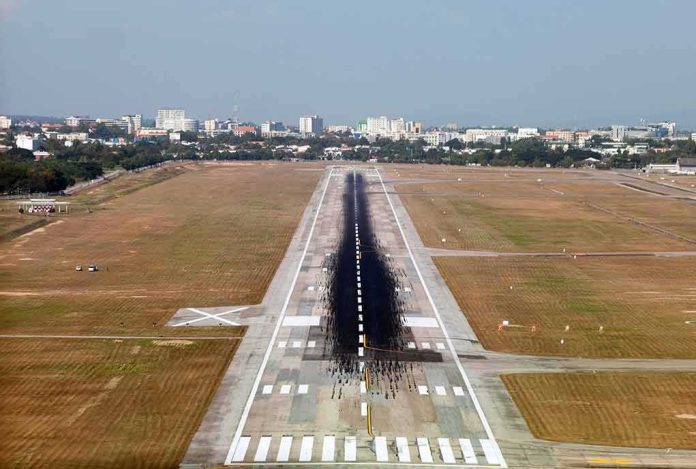
A trespasser scaled Denver International Airport’s perimeter fence, dashed onto an active runway, and met instant death under a speeding Frontier Airlines jet—exposing a chilling two-minute gap in detection that pilots barely escaped.[1]
Story Snapshot
- Trespasser jumped intact fence at Denver International Airport, reached Runway 17L undetected for two minutes before fatal strike.[1]
- Frontier Flight 4345, bound for Los Angeles with 231 aboard, aborted takeoff after pilot reported collision and engine fire.[1][6]
- Evacuation via slides caused 12 minor injuries, five hospitalized; no major harm despite smoke in cabin.[1]
- U.S. Transportation Secretary Sean Duffy called it deliberate breach; local police, FAA, TSA, and National Transportation Safety Board investigate.[1]
- Runway closed; fence intact, victim not an employee—raising questions on security vigilance.[1]
Trespasser Breaches Perimeter Security
On May 8, 2026, at approximately 11:19 p.m., an unidentified person scaled Denver International Airport’s perimeter fence near Runway 17L.[1] Airport officials confirmed the fence remained intact post-incident, and the individual reached the active runway within two minutes.[1] Transportation Secretary Sean Duffy stated the trespasser deliberately breached security and ran onto the runway.[1] Aviation protocols demand constant perimeter monitoring, yet no alerts triggered during this window.[7] This lapse fuels debate on sensor efficacy and patrol frequency at major U.S. hubs.[1]
Pilot’s Split-Second Collision and Fire
Frontier Airlines Flight 4345, an Airbus A321 carrying 224 passengers and seven crew, accelerated for Los Angeles when the pilot spotted “an individual walking across the runway.”[1][6] Air traffic control audio captured the pilot’s urgent call: “Frontier 4345, we’re stopping on the runway. We just hit somebody. We have an engine fire.”[1][6] The jet struck the trespasser at high speed, with the body partially ingested into an engine, igniting a brief fire extinguished by Denver Fire Department crews.[1] Pilots aborted takeoff immediately, averting potential catastrophe.[6]
Passenger Jose Cervantes recounted a “thud and explosion” as the plane tilted, smoke filling the cabin.[1] Controllers dispatched emergency trucks instantly, showcasing drilled response precision.[6] Such incursions remain rare but underscore runway risks where jets hit 150+ mph.[7]
Swift Evacuation Saves Lives
Crew evacuated all 231 souls via emergency slides onto the runway.[1] Buses transported passengers to the terminal; most later departed on a replacement flight.[1] Airport reports noted 12 minor injuries, with five hospitalized—none life-threatening.[1] Frontier Airlines confirmed smoke in the cabin but linked it tentatively to the strike.[1] No major injuries among passengers or crew highlight effective training and equipment.[7]
Denver Fire swiftly doused the engine fire, preventing escalation.[1] This outcome aligns with conservative values prizing personal responsibility: the trespasser’s reckless act endangered innocents, yet rapid protocols protected lives.[1] Critics questioning security overlook the pilot’s observation—detection happened, just too late to halt momentum.[6]
NEW: A man is dead after a Frontier Airlines plane struck him while attempting to take off from a runway at Denver International Airport. The FAA and NTSB are investigating the incident.
READ MORE:https://t.co/7OekIICBe6
— WTVC NewsChannel 9 (@newschannelnine) May 9, 2026
Investigations Probe Security Gaps
Local law enforcement leads the probe, supported by the Federal Aviation Administration (FAA), Transportation Security Administration (TSA), and National Transportation Safety Board (NTSB).[1] Frontier coordinates with authorities; Runway 17L stays closed for forensics.[1] Airport deems the victim not an employee, but lacks public badge logs or footage to confirm.[1]
Aviation analyst Kyle Bailey notes active runways feature stringent protocols—heavily monitored perimeters make breaches difficult.[7] Facts support this: intact fence, two-minute timeline, and pilot sighting affirm adequacy against deliberate intrusion.[1][7] Weaknesses like absent camera logs invite scrutiny, but common sense favors isolated criminality over systemic failure.[1] Rising U.S. incursions demand vigilance, yet this appears one foolhardy soul’s fatal choice.[7]
Government Accountability Office data shows 1,135 serious runway events from 2015-2022, with pedestrian breaches at 4%—often “unforeseeable” absent intel.[1] MITRE studies recommend sensors post-incident, but here protocols held: no chain-reaction crash.[1] Future FOIAs on logs could clarify, reinforcing accountability without hysteria.[1]
Sources:
[7] Person hit, killed by Frontier plane at Denver airport after jumping …