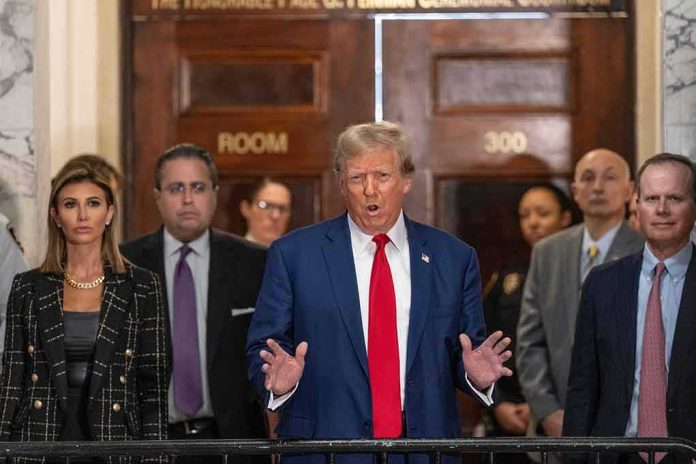
President Trump stepped off the stage mid-speech on Long Island to hug the parents of 12-year-old Bronx shooting victim Jacob Freytes, turning a policing address into a moment of public grief and resolve.
Story Highlights
- Trump paused his Nassau County Police Academy speech to comfort Jacob Freytes’ parents.
- The moment underscored his crime-focused message and promises of tougher enforcement.
- The White House amplified the clip as an “impromptu” act of compassion.
- The gesture fit a pattern where leaders’ empathy gets judged through partisan lenses.
What Happened On Stage In Garden City
On Friday in Garden City, New York, President Trump addressed law enforcement and supporters at the Nassau County Police Academy. During the speech, he mentioned 12-year-old Jacob Freytes, who was killed by a stray bullet in the Bronx last month. Trump then walked off the stage to meet Jacob’s mother, Migdalia Martinez, and his father, retired New York Police Department Sergeant Jesus Freytes, and embraced them as the crowd watched. The moment briefly paused the event’s prepared remarks.
Video shared by outlets showed Trump leaving the podium, stepping down, and hugging Martinez as she cried, before greeting Jacob’s father. Coverage described the exchange as emotional and direct, with the president choosing contact over distance. The New York Post framed the scene within a broader promise to crack down on violent crime, linking the embrace to his message that day about stronger policing and accountability for repeat offenders.
The Policy Message Tied To The Moment
Trump’s speech focused on public safety, crediting recent declines in violent crime and calling for tougher action against gun violence and repeat offenders. Supportive coverage highlighted his claim of a major national drop in violent crime in 2025 and fewer murders year over year, which he tied to a renewed push for enforcement and support for officers. The hug occurred after he invoked Jacob’s story as a reason to “make America safe again,” merging policy points with the family’s loss.
The White House amplified the clip on social media, calling it an “impromptu moment” that reflected the administration’s why for its safety agenda. The message framed the embrace as both human and political, linking compassion with the case for firmer laws and policing. Supporters saw a leader meeting grief face to face. Critics often view such scenes through a political lens, but the administration positioned the encounter as authentic to its mission.
Why These Images Carry Extra Weight
Public grief often becomes a test of a leader’s authenticity. Research on media coverage shows that news reports do more than describe these moments; they evaluate whether they seem genuine, which can harden partisan readings of the same act. That dynamic helps explain why such images can unite some and divide others. Many Americans across left and right also see a larger failure in government to keep communities safe and to put families first, which raises the stakes for how leaders show up in pain.
Trump’s stage walk aligned with his long-standing use of visual cues to claim common ground with audiences. Analysts who study his nonverbal style argue that gestures, posture, and direct contact are tools he uses to send signals of connection and control to viewers, not only to people in the room. In this case, the hug placed a grieving mother and father at the center of a policy speech, reminding the audience that crime debates are not only about numbers but names and lives.
The Shared Concerns Behind The Applause
Many conservatives see Jacob’s death as proof that soft-on-crime policies have deadly costs. Many liberals see it as proof that families in working-class neighborhoods face daily risks that go unseen. Both sides share rising doubt that Washington is protecting them or putting public safety above politics. Friday’s moment resonated because it felt local and human. It also pressed the core question most Americans keep asking: will leaders match words with results that make streets safer for every family?
Sources:
thegatewaypundit.com, nypost.com, foxnews.com, facebook.com, youtube.com, x.com, time.com