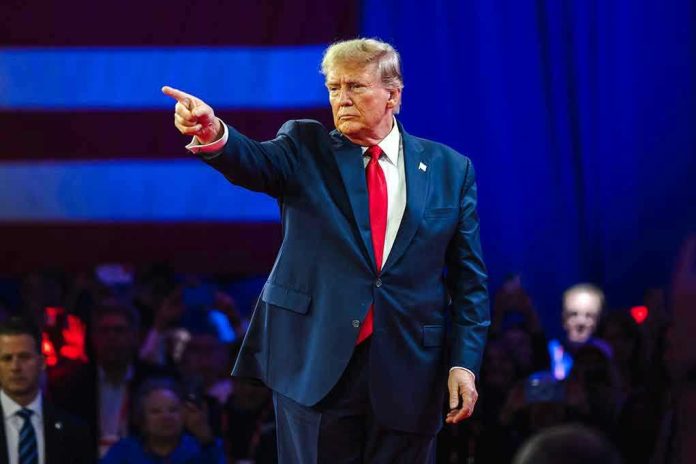
A newly released Oval Office log challenges the New York Times’ narrative about President Trump’s ‘fatigue’, raising questions about the media’s portrayal of his presidency.
Story Highlights
- The New York Times published a story questioning President Trump’s energy levels at age 79.
- Trump responded by calling the article a “hit piece” and denied claims of diminished energy.
- Oval Office logs released challenge the Times’ narrative by showing a busy presidential schedule.
- The controversy underlines ongoing tensions between Trump and mainstream media outlets.
Oval Office Logs Challenge NYT Narrative
In a striking development, newly released Oval Office logs directly counter the New York Times’ assertions about President Trump’s supposed decline in energy and work schedule. The Times, in a November 2025 article, suggested that Trump’s advanced age was impacting his duties. However, the logs reveal a packed schedule, undermining claims of fatigue and raising concerns about media bias.
Trump, now 79, holds the distinction of being the oldest person elected to the presidency. Despite this, the logs suggest he maintains a demanding workload, mirroring his first term’s pace. The Times’ portrayal of a diminished schedule thus appears misleading, fueling arguments about the reliability of mainstream media narratives.
Trump’s Response to Media Criticism
President Trump swiftly dismissed the New York Times report as a “hit piece,” taking to Truth Social to express his discontent. He accused the media of perpetuating false narratives aimed at undermining his leadership. Trump’s response resonates with his conservative base, who have long harbored skepticism toward perceived media bias against conservative figures.
Such tensions between Trump and the mainstream media are not new. During his first term, Trump frequently criticized outlets like the New York Times for what he perceived as unfair coverage. This latest controversy over the Oval Office logs underscores ongoing issues of trust and bias in media reporting.
Reactions and Implications
Conservative commentators and Trump supporters have rallied around the president, citing the Oval Office logs as evidence of media dishonesty. The incident adds to the broader discourse on media accountability and the role of journalism in shaping public perception. As the debate unfolds, it highlights the persistent divide between media narratives and the perspectives of conservative Americans.
The Oval Office logs’ release raises important questions about transparency and accuracy in reporting. As the media landscape evolves, the need for factual, unbiased journalism becomes ever more crucial, particularly in a politically polarized environment.
Sources:
Trump’s Response to New York Times Report on Age and Health