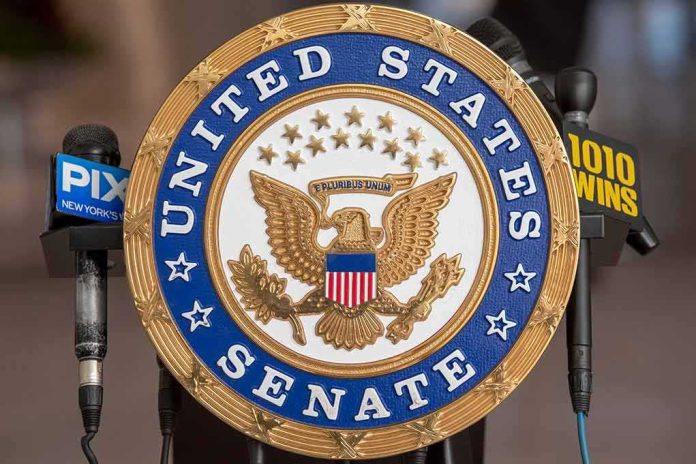
A $70 billion immigration enforcement bill just cleared the Senate, giving President Trump the tools to secure the border while Democrats rage over losing leverage on their preferred “guardrails” and Trump-related funds.
Story Snapshot
- The Senate passed a roughly $70 billion bill funding Immigration and Customs Enforcement and Border Patrol through the end of President Trump’s term.
- Republicans are framing the package as a multi-year commitment to stronger border and interior enforcement capacity.
- Democrats fought the bill for months, demanding limits and “accountability measures” that would have constrained immigration agents.
- The fight over a Trump-linked settlement or “anti-weaponization” fund became a central Democratic talking point but did not stop passage.
Senate Sends Trump a Three-Year Enforcement Funding Victory
The United States Senate approved legislation that would provide roughly $70 billion to fund Immigration and Customs Enforcement and the United States Border Patrol for three years, covering the remainder of President Trump’s term in office.[3][4] Reporting describes the bill as a three-year immigration enforcement package, not a symbolic resolution, aimed at ending a months-long blockade by Democrats who had refused to move enforcement money without policy concessions.[3][4] The vote reportedly passed by a narrow majority, around 52 to 47, signaling unified Republican support and near-unified Democratic opposition.[2][3]
News accounts say Republicans used a budget process maneuver to advance the bill on a simple majority basis, bypassing the usual sixty-vote filibuster threshold that Democrats had used to stall enforcement funds.[1][3] The package is framed by supporters as a way to take Democratic leverage off the table by locking in multi-year appropriations for immigration enforcement agencies through 2029.[1][4] That structure lets the Trump administration plan hiring, detention, transportation, and operational support with more certainty than a single-year stopgap or continuing resolution would allow.[1][4]
What the $70 Billion Enforcement Package Actually Funds
Democratic appropriations staff characterize the Department of Homeland Security bill as providing more than $70 billion specifically for Immigration and Customs Enforcement and Customs and Border Protection, alongside other Department of Homeland Security accounts.[2][4] A Democratic committee release claims the package includes about $38.2 billion for Immigration and Customs Enforcement and $26 billion for Customs and Border Protection, with additional money for the Department of Justice and the United States Secret Service.[2] Advocacy organizations critical of enforcement describe the bill as “$70 billion more for Immigration and Customs Enforcement and Customs and Border Protection through 2029,” underscoring that these are operational funds, not abstract policy statements.[4][5]
Conservative readers should note that even critics concede the core point: this is a real enforcement funding bill that sends tens of billions directly to the agents, detention beds, flights, and support operations that carry out immigration law.[2][4][5] Unlike past fights where Congress passed messaging resolutions without teeth, this package represents a substantial long-term appropriation that shapes the Department of Homeland Security’s enforcement footprint for the rest of Trump’s presidency.[1][3][4] However, none of the supplied records provide detailed line-by-line statutory language, so outside observers cannot yet independently verify every account, earmark, or restriction baked into the final text.[2][4]
Democrats Focus on “Slush Funds” While Opposing Enforcement Expansion
Democrats spent months blocking the bill, demanding policy changes and “guardrails” on enforcement agents after high-profile incidents involving federal officers and protesters earlier in the year.[3][4] Coverage says Senate Democrats pushed amendments to limit or eliminate a Trump-linked settlement or “anti-weaponization” fund, which they labeled a “slush fund,” and tried to send the immigration bill back to committee when those restrictions were rejected.[3] Minority Leader Chuck Schumer and other critics argued that Republicans were pairing expanded enforcement dollars with preservation of Trump-related funds they viewed as politically abusive.[1][3]
That strategy produced weeks of delay but ultimately failed when a Republican majority held together to defeat the Democratic amendments and push the core enforcement bill to final passage.[1][3][4] Opponents have not, in the available record, produced empirical evidence that the $70 billion will fail to enhance border security; their case is focused instead on concerns about unchecked enforcement powers, civil liberties, and the separate Trump-linked fund dispute.[1][4][5] Advocacy groups like the American Civil Liberties Union urge “no more funding for Immigration and Customs Enforcement and Border Patrol with absolutely no strings attached,” underscoring that the left’s core objection is ideological opposition to aggressive enforcement itself.[5]
The Senate passed a roughly $70 billion reconciliation bill in a 52–47 vote to fund Immigration and Customs Enforcement and the Border Patrol through the end of Trump’s term…the bill will now head to the House for a vote
— Simple American News 🗞️ (@TSimpleAmerican) June 5, 2026
From a conservative perspective, the political landscape is clear: Republicans have delivered a rare multi-year enforcement win, while Democrats are more animated by efforts to constrain Trump and his agencies than by securing the border or restoring respect for the rule of law.[1][3][4][5] At the same time, the public record still lacks key implementation details, such as Department of Homeland Security budget execution plans, hiring timelines, detention capacity upgrades, and internal performance targets for removals and border apprehensions tied directly to this money.[1][4] Until those documents and subsequent metrics emerge, citizens can say with confidence that Congress has funded enforcement; whether agencies fully convert dollars into tighter borders and interior control remains an open, measurable question.[1][4]
Sources:
[2] YouTube – Senate Republicans pass $70B bill funding ICE, Border Patrol
[3] Web – Senate passes $70B immigration enforcement bill – 88.5 WFDD
[4] YouTube – Senate approves $70B immigration enforcement bill
[5] Web – Senate passes $70B immigration enforcement bill – KGOU