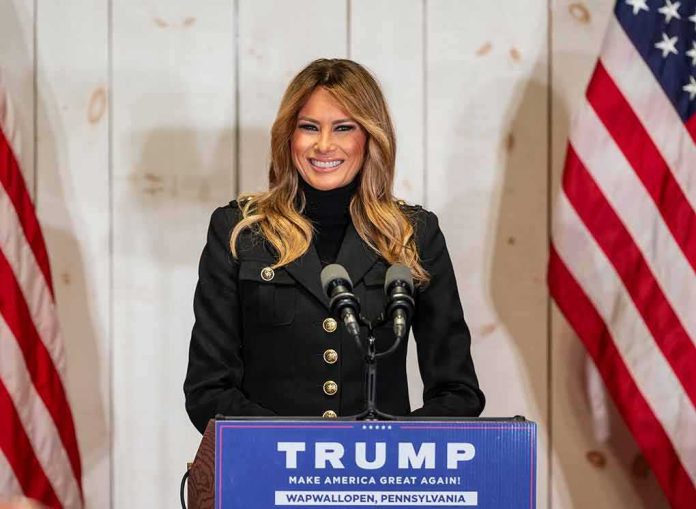
The White House says First Lady Melania Trump helped broker a six-day ceasefire in war-torn Oleshky that let hundreds of civilians escape and aid get in.
Story Highlights
- The White House credited Melania Trump with initiating talks and securing a localized ceasefire in Oleshky.
- Russia and Ukraine sent representatives to the White House to discuss next steps after the pause.
- The pause ran about six days and focused on evacuations and aid delivery, not a wider peace deal.
- Officials reported nearly 800 evacuees and improved humanitarian access during the window.
What The White House Announced And Why It Matters
The White House stated that First Lady Melania Trump independently opened channels with Russia and Ukraine and secured a localized ceasefire in Oleshky, a city in Ukraine’s Kherson region. The administration said both sides agreed to stop military action there to allow aid to enter and people to leave safely. This matters because local pauses can save lives even when national-level talks stall. It also places a First Lady at the center of an active conflict event.
The White House outlined terms for the pause. Those terms included a halt to fighting in and around Oleshky, set times for aid convoys, and a marked evacuation route for civilians. The announcement framed the goal as purely humanitarian, not a long-term political settlement. That framing tracks with how short, local ceasefires often work. They focus on access and safety rather than borders or broader war aims, which are harder to settle quickly.
Who Met In Washington And What They Discussed
Officials from both countries were scheduled to visit the White House following the pause. CNN reported that Ukraine’s human rights ombudsman Dmytro Lubinets and Russia’s human-rights commissioner Yana Lantratova would attend, citing each side’s authorities. The meeting aimed to discuss results from Oleshky and whether similar windows could help other areas. Such talks can set practical steps, like shared hotlines and convoy timing, which make future pauses safer.
Media reports described the ceasefire as time-limited and local. Canadian coverage said the pause ran from October 27 through November 1, 2026, enabling aid delivery and evacuations in the area. The Hill reported a 3 a.m. local start on October 27 and noted a geographic adjustment to help convoys move more safely. These details point to a structured, short window focused on moving people and supplies, not a broader end to the conflict.
Humanitarian Impact And What We Know So Far
The White House said the operation helped evacuate nearly 800 people from Oleshky and nearby areas and allowed emergency supplies to reach residents facing shortages of food and medicine. Local reporting echoed that figure and described aid getting through during the pause. Even a few days without shelling can create a lifesaving gap for families. It also gives aid groups time to stage deliveries and assess which neighborhoods need the most help.
HAPPENING NOW
First Lady Melania Trump just walked out with officials from BOTH Russia and Ukraine at the White House following her historic Oleshky ceasefire deal to allow humanitarian aide:
"Together, we can create something MORE ENDURING than a temporary ceasefire!"… pic.twitter.com/zCwGJU2Vfj
— Conservative Brief (@ConservBrief) November 5, 2026
Local ceasefires tend to be fragile and narrow, but they can reduce harm when managed well. Research on ceasefires finds that short pauses work best when parties have clear rules, communication channels, and ways to fix problems fast. Monitoring and information-sharing reduce confusion and help prevent incidents from spiraling into renewed violence. The Oleshky pause fits that pattern: limited in time and space, but designed to protect civilians and allow aid to flow.
Sources:
youtube.com, whitehouse.gov, cbc.ca, themoscowtimes.com, thehill.com