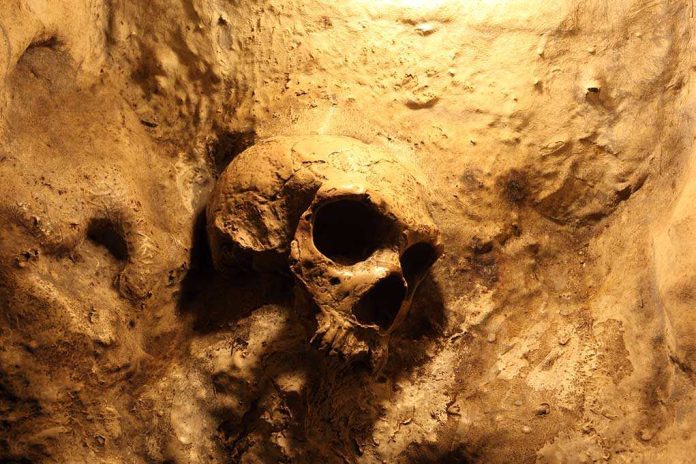
One battered skull dug from Chinese river mud has forced scientists to rip up the human family tree and start again—raising the question: what else do we think we know about our origins that might be completely wrong?
Story Snapshot
- A digitally reconstructed skull from China pushes back the split between modern humans and our relatives by 400,000 years.
- This fossil blurs the lines between primitive and modern, adding chaos to the story of where we came from.
- The find exposes the power of new technology to overturn decades of “settled” science about human evolution.
- Experts disagree on what the skull means for our species—but they agree it’s a game changer.
Ancient Skulls, New Mysteries: The Discovery That Changed Everything
A partial skull known as Yunxian 2, unearthed in the late 1980s from river-terrace sediments in Hubei Province, China, languished for decades as a scientific footnote. Crushed and deformed, it resisted every attempt at meaningful analysis until 2025, when a team of Chinese and international researchers wielded advanced digital tools to reconstruct it. Their findings, published in the journal Science, have rattled the foundations of human evolution. The skull, they say, belongs to a lineage that split from modern humans 1.3 million years ago—hundreds of thousands of years before previously accepted timelines. That’s not a minor footnote in the evolutionary ledger. It’s a rewriting of the first chapters of our own origin story.
Digital reconstruction finally revealed the skull’s hybrid character: a mosaic of ancient and more modern features, neither fully primitive nor fully modern. This enigmatic mix suggests a transitional form, one that doesn’t fit neatly into currently recognized human species. The fossil’s age and traits hint at a tangled web of human evolution in East Asia, complicating the idea that our family tree has a single root or tidy branches. Instead, it exposes the story of Homo as a bush—full of surprises, dead ends, and unexpected connections.
The Science Behind the Skull: Technology and Teamwork Rewrite the Rules
The Yunxian 2 skull spent decades in scientific limbo, too mangled for traditional study. Only recent leaps in CT scanning and 3D digital reconstruction unlocked its secrets. Researchers led by Xiaobo Feng of Shanxi University and Xijun Ni of Fudan University painstakingly restored the fossil virtually, then compared it to over 100 other ancient human remains. Their analysis placed Yunxian 2 on a branch that diverged from the lineage leading to both modern humans and Denisovans—a mysterious group thought to have roamed Asia for hundreds of thousands of years. The new timeline pushes this divergence back by more than 400,000 years, forcing scientists to reconsider everything from migration patterns to the origins of modern human traits.
This new perspective doesn’t just add a new branch to the tree. It redraws the entire map of early human evolution. Genetic studies previously pegged the split between Homo sapiens and groups like the Denisovans at around 500,000–700,000 years ago. The Yunxian 2 data now suggests a much earlier and more complicated separation, especially in Asia—a region often overshadowed by the famous African and European finds.
Tangled Roots: How Yunxian 2 Upends the Textbooks
Fossils from Asia have always been the wild cards in the game of human evolution. Finds like Harbin, Dali, and Jinniushan have repeatedly challenged the notion of a simple, linear progression from primitive to modern. Yunxian 2, with its blend of old and new, takes this uncertainty to new heights. It suggests that key evolutionary events happened much earlier, and possibly in places scientists have barely begun to explore. This means the story of human origins is far more complex—and more Asian—than most textbooks admit.
The implications are profound. In the short term, the discovery will trigger a flurry of new research and debate, as scientists rush to re-examine fossils and update their models. In the long term, it could force a complete rewrite of how we teach human evolution, shifting the spotlight eastward and giving new weight to fossils long ignored.
The Stakes and Skeptics: Experts React to a Shifting Story
Not all experts are ready to throw out the old models just yet. Robin Dennell, a prominent paleontologist not involved in the study, called the digital restoration a “benchmark” for the field but urged caution in assigning new species names based on a single fossil. Other researchers emphasize the need for more specimens and more data before redrawing the entire family tree. Still, there is a growing consensus that Yunxian 2 marks a turning point—a pivotal find that will shape research agendas and scientific debates for years to come.
For the Chinese research teams and their international partners, the discovery is a triumph of persistence and innovation. It also signals the growing scientific clout of Asian institutions, which are now leading the charge in paleoanthropology. The Yunxian site itself is poised to become a hotspot for further discoveries, with plans to excavate deeper layers and analyze newly unearthed skulls. The race is on to find more fossils, more clues, and perhaps more surprises that could once again upend everything we thought we knew about ourselves.