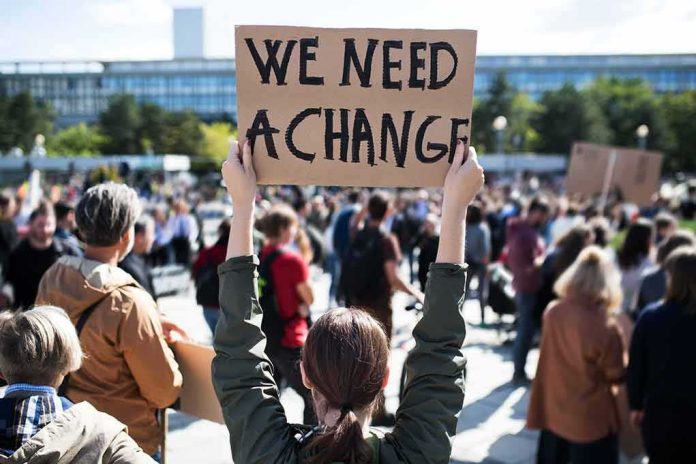
Masked students at Middle Tennessee State University marched to demand a campus group’s ban after a speaker they call harmful, while the chapter doubled down on free speech and refused to apologize.
Story Snapshot
- About 30 students marched at Middle Tennessee State University and urged a ban on a Turning Point USA chapter.
- A petition gathered over 550 signatures to disband the chapter and bar speaker Joshua Haymes from campus.
- Protesters alleged “white nationalist” and anti-LGBTQ+ rhetoric; no transcript or ruling confirms what was said at the event.
- The chapter cited the First Amendment and said it would not apologize or regret hosting the event.
What Sparked The Protest
Local reporting said roughly 30 masked students marched at Middle Tennessee State University on November 12, 2026. They chanted “Fascists off our campus” and called for the Turning Point USA chapter to be dissolved. They also demanded that guest speaker Joshua Haymes be barred from campus. Organizers tied their demands to an October event that they said included racist and anti-LGBTQ+ attacks and “white nationalist rhetoric.” A companion petition collected more than 550 signatures.
The protesters’ claims target both the content and the presence of Haymes. Haymes is a former pastor and podcast host who has drawn sharp criticism in past coverage. National and campus outlets have described him as “Christian nationalist,” and some commentary highlights statements like calling Adolf Hitler “misunderstood,” though those remarks were not documented as occurring at Middle Tennessee State University specifically. That gap matters for any campus sanction focused on this event.
The Chapter’s Free Speech Response
The Turning Point USA chapter at Middle Tennessee State University said the event was an open debate where students could grab a microphone and challenge ideas. The chapter issued a statement citing the First Amendment of the Constitution of the United States. It said it promotes free speech on campus and would not apologize or regret hosting Haymes or other speakers. It urged the university to follow law and policy and noted that unhappy students could leave the event.
Campus reporting earlier in the year said Haymes’s appearances drew hundreds of students from different political backgrounds. Supporters frame these events as debate-driven and open to all, not as closed rallies. That framing strengthens a viewpoint-neutral defense, especially when specific policy violations are not shown. It also places pressure on university leaders to balance safety concerns with constitutional speech duties at a public school.
What We Know—and What We Do Not
The public record does not yet include a transcript, recording, or official findings about the October event at Middle Tennessee State University. The protest and petition show organized opposition, but signatures reflect support, not proof of specific statements. Reporting also did not identify a university disciplinary decision or a violation tied to this event. That leaves the dispute centered on principle: harassment claims versus viewpoint neutrality and open debate on a public campus.
@MarshaBlackburn @timburchett @RepTimBurchett
Protest to remove Turning Point USA chapter at MTSU https://t.co/qsWzCOKCdV via @YouTube
— Tokaise (@Tokaise) November 16, 2026
This clash echoes a national pattern. Many campuses see calls to cancel or disinvite speakers, while others warn against censorship. Surveys by the Foundation for Individual Rights and Expression describe rising tension around speech, with growing comfort with “shouting down” speakers among some students. Still, most controversial events are not canceled, and public universities must meet constitutional standards before restricting speech or clubs based on viewpoint.
Why This Matters Beyond One Campus
Parents and taxpayers see colleges funded by public dollars struggle with core duties. Students want safety and dignity. Other students want robust debate, even on hard topics. When leaders fail to set clear, fair rules and show their work, trust crumbles. Clear evidence, consistent policy, and equal treatment are the guardrails that protect both free speech and vulnerable students. Without them, people across the political spectrum see a system that serves insiders, not citizens.
What To Watch Next
Watch for any formal action by Middle Tennessee State University, such as incident findings, policy reviews, or updated event rules. Look for primary evidence from the October event, like video or transcripts, that can confirm or refute the core allegations. Track whether the petition prompts a policy change, or if the university reaffirms speech protections with clearer enforcement lines for threats and harassment. Those steps will show whether leaders can balance rights and safety without playing politics.
Sources:
thegatewaypundit.com, wsmv.com, talkingpointsmemo.com, lmtribune.com, ground.news, thenexus.news, mtsusidelines.com