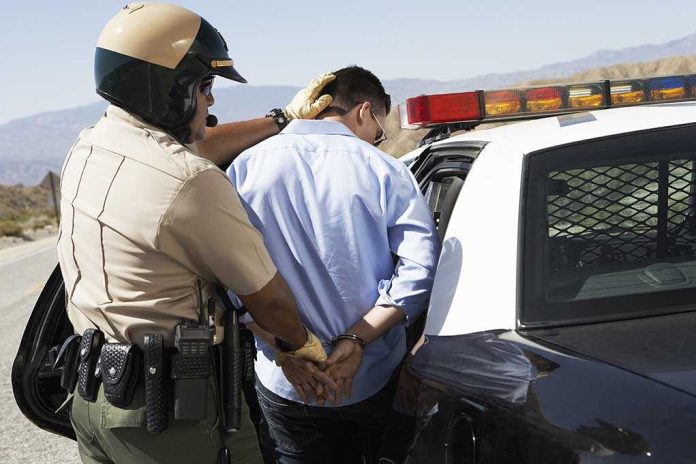
A Mexican cartel boss faked his own death, slipped into California, and lived among Americans before the system finally caught him.
Story Snapshot
- A Mexican cartel leader who staged his own death quietly resettled in California under an alias.
- Federal prosecutors secured an 11-year prison sentence after his 2024 arrest in the United States.
- The case underscores long-standing failures of border security and immigration enforcement under prior leadership.
- Trump’s renewed crackdown on cartels and border crime contrasts sharply with years of lax, politically driven policies.
Cartel Leader’s Fake Death and Quiet Life in California
Cristian Fernando Gutierrez-Ochoa, a Mexican cartel leader, reportedly went so far as to fake his own death before making his way into the United States. According to coverage cited by CBS News, he then settled in California and lived under an alias, blending into a state already burdened by crime, drugs, and illegal immigration. Authorities ultimately arrested him in 2024, exposing how thoroughly he had manipulated weak points in cross-border enforcement and identity verification systems.
Federal prosecutors have now secured an 11-year sentence in federal prison for Gutierrez-Ochoa, closing one chapter in a case that highlights how dangerous actors can exploit U.S. vulnerabilities. Sentencing him keeps a proven cartel operator off American streets for more than a decade, but it also raises hard questions. How many others with similar backgrounds crossed the border, obtained housing, and integrated into communities while Washington obsessed over woke agendas instead of front-line security and law enforcement tools?
Border Security Gaps Exposed by a Cartel Boss in the Suburbs
The fact that a cartel honcho could fake his death and then quietly reside in California underscores how broken the prior border and immigration systems had become. When federal agents finally moved in, they were not just making one arrest; they were confronting the consequences of policies that had treated border enforcement as a political bargaining chip. The case illustrates how loose entry controls, identity fraud, and sanctuary-style attitudes can combine to give violent organizations effective shelter inside the United States.
For many Americans, especially along the southern border, this story confirms what they have long believed from personal experience: cartels do not just operate “over there.” Their leadership, money, and drugs spill into U.S. communities when the federal government refuses to treat the border as a national security line. Allowing cartel figures to live under assumed identities erodes trust in government, undermines the rule of law, and leaves families wondering who is really moving in next door, all while politicians in safe neighborhoods lecture about “compassion.”
Trump’s Renewed Crackdown on Cartels and Illegal Entry
With Trump back in the White House, the federal posture toward cartels and illegal border activity has shifted sharply toward enforcement and deterrence. The administration has designated multiple Latin American cartels as terrorist groups, signaling that cartel operations are treated as organized warfare against American communities rather than just another criminal issue. That framework supports tougher prosecutions, stronger intelligence sharing, and more aggressive disruption of financial and logistical networks that make stories like Gutierrez-Ochoa’s possible.
That broader crackdown pairs with efforts to close the border, stop human and drug trafficking, and ensure that benefit programs serve citizens rather than those who game the system. The message to cartel leadership is that the era of using the United States as a safe harbor is over. For readers who watched years of half-measures and excuses, the contrast between a cartel boss quietly living in California and a government finally treating cartels as national security threats confirms why border sovereignty and strict enforcement remain top conservative priorities.
Accountability, Rule of Law, and Protecting American Communities
Gutierrez-Ochoa’s 11-year sentence demonstrates that, when law enforcement is empowered and backed by clear policy, dangerous actors can be located, prosecuted, and removed from American streets. The challenge is ensuring this is the rule, not the rare success story. Conservative voters want a system where faking your death and slipping into California is nearly impossible, where every level of government cooperates to identify and remove cartel-linked individuals before they plant deeper roots.
Looking ahead, the lesson from this case is simple: border security, immigration enforcement, and serious anti-cartel policy are not abstract talking points. They determine whether families in American neighborhoods live next to law-abiding neighbors or to cartel operatives hiding behind false names. Restoring the rule of law, prioritizing citizen safety, and rejecting open-border experiments are central to preventing the next cartel fugitive from treating the United States as his retirement plan.