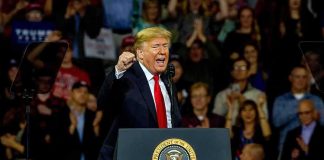
After a fourth attempt on President Trump’s life, Rep. John James blasted the “fake news” echo chamber as a catalyst for danger—reviving a high-stakes fight over whether reckless rhetoric is fueling political violence.
Story Highlights
- Rep. John James condemned mainstream media rhetoric after the latest attempt on President Trump’s life, echoing immediate grass-roots anger at reporters on scene [1].
- Polling shows many Americans see heated rhetoric as a contributor, while assigning primary responsibility to the attacker [5].
- Federal investigators concluded the Butler, Pennsylvania, shooter acted alone, undercutting claims of organized media incitement [6].
- University commentary and workplace fallout show a wider reckoning over violent political speech and its real-world consequences [4][13].
James’s Charge: Media Rhetoric Crossed a Dangerous Line
Rep. John James’s rebuke followed a familiar pattern after the shots: Trump allies and supporters confronted reporters, accusing the press of stoking hatred. Witnesses shouted, “This is your fault!” at journalists immediately after the failed assassination attempt, while Donald Trump Jr. tied the danger to years of dehumanizing labels from political opponents and their media allies [1]. James’s argument fits that frame: when the press normalizes depictions of Trump as a threat to democracy, it lowers the guardrails against violence for unstable individuals.
Americans are not blind to the atmosphere. A YouGov survey taken in the week after the first near-fatal attempt found that many Americans believed inflamed rhetoric played a role, even as they still held the shooter chiefly responsible [5]. That dual judgment tracks with common sense: words matter, and the country understands that media tone can escalate tensions. James is channeling that public intuition while demanding accountability from institutions that shape national perception daily.
What We Know Officially: The Shooter Acted Alone
The Federal Bureau of Investigation (FBI) concluded that the Butler, Pennsylvania, attacker, Thomas Matthew Crooks, acted alone. The public summary reports the ear injury to President Trump came from a bullet or fragment fired from the attacker’s own rifle, which anchors the facts to a single perpetrator rather than any organized plot or outside handler [6]. That conclusion directly challenges assertions that media outlets “caused” the attack in a proximate or coordinated sense.
The official record matters because it sorts causation from climate. Federal findings assign operational responsibility to one gunman, not to a newsroom or a political party [6]. Yet the findings do not settle the moral debate James is raising. Conservatives can accept the lone-actor conclusion while still condemning a years-long pattern of vilifying rhetoric that paints political adversaries as subhuman or “enemies,” a pattern that predictably increases the odds that an extremist will act on those cues.
Public Reaction and Elite Messaging After the Attacks
Media outlets themselves chronicled the immediate blame placed on journalists by Trump supporters at the scene, capturing the raw anger that has built up over years of one-sided narratives and character assassination [1]. Elsewhere, college campuses and employers wrestled with the fallout from posts appearing to cheer the violence, prompting disciplinary actions and reigniting debates over academic freedom, workplace standards, and the line between speech and endorsement of harm [4][13]. Those reactions show that the culture understands there is a rhetorical red line—cross it, and consequences follow.
Broader commentary underscores that contentious talk is not a one-off factor but part of a combustible mix that includes mental health, radicalizing online networks, and distrust in institutions. Even so, Americans still place principal blame on the individual attacker, a view that is both morally sound and compatible with James’s demand that elite institutions stop bathing the country in incitement-adjacent narratives [5]. That is not censorship; it is a call for adults in positions of influence to act like it.
Conservative Takeaway: Protect Speech, Reject Dehumanization
Conservatives can hold two truths: First, the Constitution’s free speech protections remain nonnegotiable. Second, leaders and media figures bear a civic duty to avoid the dehumanizing tropes that, over time, desensitize unstable actors to violence. Polling shows many Americans already connect heated rhetoric to elevated risk, while the FBI’s lone-gunman finding keeps accountability where the law requires it—on the perpetrator [5][6]. James’s warning targets the culture-makers who profit from outrage without owning its societal cost.
The path forward is clarity and courage. Journalists should stop laundering partisan smears as “analysis.” Politicians should retire violent metaphors and moral absolutism. Institutions should enforce standards consistently, as recent employment actions signaled, regardless of which party is targeted [13]. The Trump administration can also press agencies to fortify event security and counter online radicalization while defending lawful speech. America can reduce the heat without surrendering liberty—and it must, before rhetoric turns into tragedy again.
Sources:
[1] Web – ANALYSIS: Trump supporters blame media for shooting
[4] Web – Does academic freedom excuse posts on assassination attempt?
[5] Web – What Americans believe about the attempted assassination on …
[6] Web – Attempted assassination of Donald Trump in Pennsylvania – Wikipedia
[13] Web – Employees let go following reaction to Saturday’s assassination …