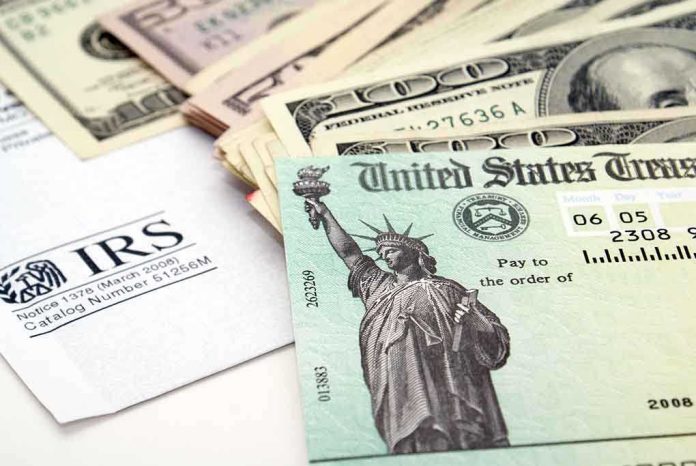
A Trump economist is promising American families the largest tax refunds in the nation’s history, with some households potentially receiving $11,000 to $20,000 in savings when they file their 2025 returns next spring.
Story Highlights
- Kevin Hassett predicts the “biggest refund cycle ever in the history of America” for 2026
- Trump claims families could see $11,000-$20,000 in annual savings from tax changes
- Retroactive 2025 tax cuts weren’t reflected in withholding tables, creating massive overwithholding
- Oxford Economics estimates $50 billion in additional taxpayer savings, roughly 17% more than typical refunds
- Benefits heavily favor higher-income households due to expanded SALT deductions and business provisions
The Bold Prediction That Has Everyone Talking
Kevin Hassett, Trump’s Director of the National Economic Council and leading contender for Federal Reserve Chair, appeared on Fox Business Thursday morning with a jaw-dropping forecast. Americans will experience “massive refund checks” in what he calls the “biggest refund cycle ever in the history of America” when they file their 2025 tax returns in early 2026.
Hassett’s prediction backs up Trump’s own speech from the night before, where the President declared next spring would bring “the largest tax refund season of all time.” But here’s where it gets interesting: Trump didn’t stop at superlatives, putting specific numbers on the table with claims that many families could pocket $11,000 to $20,000 in annual savings.
The Mechanics Behind the Windfall
The source of these projected massive refunds lies in a classic government timing mismatch that taxpayers rarely see coming. Trump’s tax and spending package passed in July 2025 included several retroactive tax cuts for the entire 2025 tax year, but the IRS never updated the withholding tables that employers use to calculate payroll deductions.
Nancy Vanden Houten from Oxford Economics explains the mathematical reality: Americans have been overwithholding taxes all year based on the old, higher rates while their actual tax liability dropped significantly mid-year. The result? A massive overpayment that must be returned as refunds when people file their returns.
Who Really Benefits From This Bonanza
Oxford Economics estimates the total additional taxpayer savings at roughly $50 billion, which would boost total refunds by approximately 17% compared to the previous year’s $275 billion. The average 2025 refund was $2,939, so a 17% increase would add almost $500 more per taxpayer on average.
But the devil lurks in the distributional details. The Tax Policy Center’s analysis reveals that while all income groups benefit on average, high-income households capture the lion’s share of savings. The expanded SALT deduction cap increase to $40,000 and new pass-through business loopholes primarily benefit affluent taxpayers who itemize deductions and own businesses.
Economic Reality Check
Hassett frames the coming refund surge as validation of Trump’s economic policies, citing 3.7% wage growth against 1.6% core inflation as evidence of real purchasing power gains. He points to what he calls a “blockbuster” November CPI report showing inflation lower than expected, arguing the administration has engineered a return to the “3% growth, 1% inflation” regime of Trump’s first term.
Yet this optimistic narrative runs headlong into public sentiment. A Fox News poll shows 44% of Americans say they’re falling behind financially, while 74% describe the economy as “not so good” or “bad.” Hassett acknowledges this disconnect but predicts attitudes will shift once people “see it in their wallets” through these massive refunds.
The Broader Political Calculation
The timing of these predictions isn’t coincidental. With Hassett positioned as a leading Fed chair candidate, his credibility matters beyond typical political messaging. These refund promises serve as concrete, measurable proof points that ordinary families will experience directly, rather than abstract economic statistics they must take on faith.
Oxford Economics expects about 64% of taxpayers will spend their refunds quickly based on historical patterns, with top-income households spending roughly 20% of their tax savings while other households spend 25-40%. This suggests a temporary but noticeable boost to consumer spending in the first half of 2026, concentrated around refund season.
Sources:
Trump economist predicts ‘biggest refund cycle ever,’ massive checks ahead
Larger tax refunds in 2026 expected