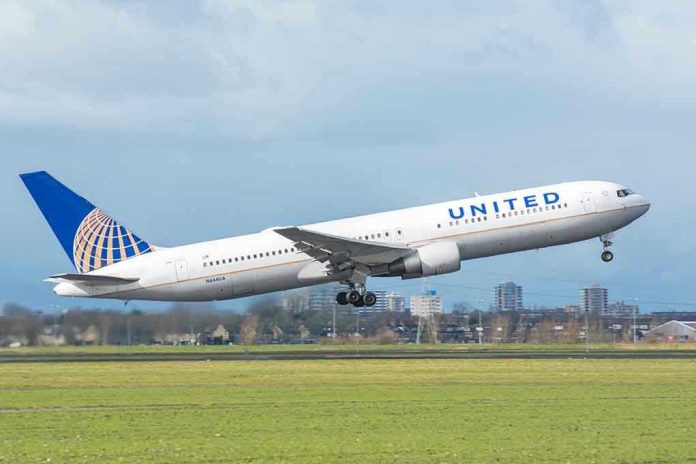
A commercial jet can swallow a bird and keep going, but a “red, shiny” mystery object at 3,000 feet exposes a scarier truth: America’s airspace is getting harder to police.
Story Snapshot
- United Airlines Flight 1980 reportedly struck a small object on approach into San Diego, at about 3,000 feet.
- The pilot described it as “red” and “shiny,” and said it was so small he couldn’t clearly identify it.
- The report surfaced through circulating air-traffic-control audio shared on social media and aviation apps, not an official announcement.
- The flight landed safely, with no reported injuries or visible damage in the initial account.
A “Drone Strike” With No Smoking Gun, Just Audio and Altitude
United Airlines Flight 1980, a Boeing 737 headed from San Francisco to San Diego, reportedly hit a small object near San Diego International Airport. The pilot’s post-landing report to ground control described a “red” and “shiny” object, with the pilot adding it was so small he couldn’t be sure what it was. The detail that grabs aviation professionals isn’t the color; it’s the altitude—around 3,000 feet.
The public learned about the incident the modern way: a clip of ATC audio circulating online, turning an operational safety report into a viral suspense story. That matters because audio can be real and still incomplete. The pilot’s words carry weight, but they don’t substitute for a confirmed identification, a maintenance inspection report, or an FAA statement. The responsible read is “reportedly hit a drone,” with “unidentified object” still on the table.
Why 3,000 Feet Is the Part That Should Bother You
Drone rules exist for a reason. Typical U.S. recreational drone operations fall under strict limits that keep small unmanned aircraft away from manned traffic: generally below 400 feet unless the operator has a waiver or qualifies under narrow exceptions. Three thousand feet sits in a zone where airliners and business aircraft routinely configure, descend, and concentrate. Put plainly: if a consumer drone truly reached that altitude near a major airport, somebody broke the rules in a way that invites harsh scrutiny.
San Diego’s airport environment magnifies the risk. The field sits tight against dense neighborhoods and busy roadways, with approaches that funnel aircraft over populated areas. That geography creates a perfect storm for careless hobbyists: lots of tempting views, lots of “just one quick shot” rationalizations, and a short distance between backyard launches and critical flight paths. A single operator’s bad decision can become a cockpit surprise with seconds to react.
The Object Could Be a Drone, or It Could Be Something Else
The pilot’s description sounded like a drone, but he also acknowledged uncertainty. That uncertainty isn’t a weakness; it’s professional honesty. At approach speeds, even a trained crew can struggle to identify a tiny object after impact. Birds remain a frequent hazard. Balloons and lightweight debris can drift where they shouldn’t. The key distinction is consequences: a bird strike is a known risk with established procedures, while a drone-like object suggests a preventable human choice.
Social media doesn’t like uncertainty, and aviation safety depends on it. The internet wants a culprit, a brand name, and a villain with a face. Investigators want the boring stuff: where the aircraft was, what sensors recorded, what the airframe shows on inspection, and whether anyone reported a drone flight nearby. Until those facts exist, the public should resist treating a dramatic audio clip as a complete case file, no matter how “scary” it sounds.
The Bigger Pattern: Drone Incursions Are Not a One-Off Problem
Drone incident databases have logged a rising number of events globally since 2021: unauthorized operations, close calls, and suspected strikes. The trend aligns with common sense. More drones in more hands means more opportunities for mistakes, stunts, and rule-breaking. Enforcement struggles to keep up because the operator can disappear in seconds, and the device itself might never be recovered. That gap leaves pilots and passengers absorbing the risk created on the ground.
Americans over 40 understand the uncomfortable parallel: rules without enforcement become suggestions. Regulators can publish altitude limits and airport buffers all day, but deterrence comes from the likelihood of getting caught. A conservative, practical approach doesn’t start with grand new bureaucracies; it starts with targeted tools that actually work. Remote identification, real penalties for repeat offenders, and cooperation with local law enforcement are boring, unglamorous, and exactly what reduces reckless behavior.
What Happens Next When the Facts Are Thin
The reported “no injuries, no damage” outcome is good news, but it also creates a trap: the temptation to shrug it off. Aviation safety is built on learning from near-misses, not waiting for catastrophe. A confirmed drone strike at 3,000 feet would raise questions about how the device got there, why geofencing didn’t stop it, and whether detection around busy airports is adequate. A misidentification would raise a different question: how quickly can investigators rule out drones and reassure the public with evidence?
United Airlines flight reportedly hits drone at 3,000 feet over San Diegohttps://t.co/6UHJ8JSaU3
— Bodoxstocks (@bodoxstocks) April 29, 2026
The story’s most important open loop remains unresolved: nobody has publicly identified the object. That silence doesn’t prove a cover-up; it usually means verification takes time and officials avoid speaking before they can stand behind the conclusion. Readers should watch for a follow-up that includes maintenance findings, radar or surveillance confirmation, and any enforcement action. Until then, the most honest takeaway is also the most sobering: the system is reacting after the fact, not preventing it.
Sources:
United Airlines flight 1980 reportedly hit by drone above San Diego
Jacksonville International Airport