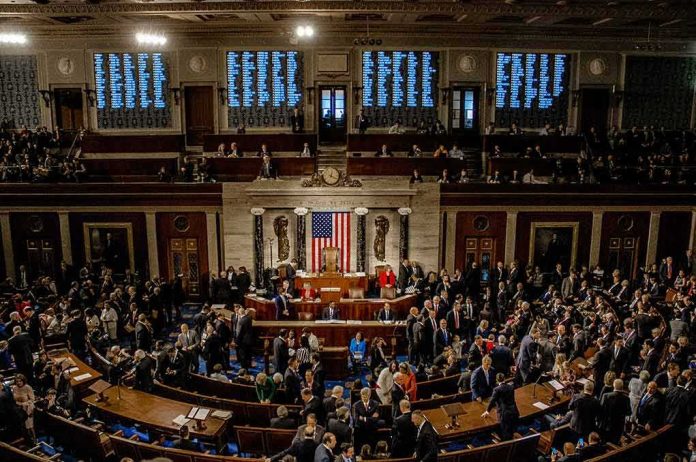
The U.S. Senate just voted 99-0 to stop paying itself during government shutdowns — and the story of how long that took is more infuriating than the shutdowns themselves.
Story Snapshot
- Senator John Kennedy’s resolution to withhold senators’ pay during government shutdowns passed a procedural vote 99-0 on May 13, 2026.
- Pay is placed in escrow, not permanently forfeited, and released once the shutdown ends — Kennedy calls it “shared sacrifice.”
- The resolution applies only to the Senate and cannot take effect until after the November 2026 elections due to the 27th Amendment.
- Democrats previously blocked the measure multiple times, and the resolution still does not guarantee that federal workers get paid during shutdowns.
A Simple Idea That Took Years to Advance
Senator John Kennedy of Louisiana first introduced legislation to stop congressional paychecks during government shutdowns back in 2019, when 800,000 federal workers went without pay during the longest shutdown in American history. The idea was straightforward: if federal workers don’t get paid, neither should the senators responsible for the funding failure. It took until December 2025 for the Senate Rules and Administration Committee to advance the measure unanimously, and until May 2026 for the full Senate to vote 99-0 to proceed. [5]
Kennedy’s resolution, Senate Resolution 526, changes Senate rules to place senators’ salaries into escrow the moment a government shutdown begins. Pay is released once funding is restored. It does not require approval from the House or the president, which is precisely why it could move without getting buried in the broader legislative graveyard. Senate Majority Leader John Thune publicly backed the measure as a good policy and an “additional incentive” to avoid shutdowns. [2][3]
The 27th Amendment Wrinkle That Limits Immediate Impact
There is a constitutional catch that deserves more attention than it has received. The 27th Amendment bars any law changing congressional compensation from taking effect until after the next House election. That means Senate Resolution 526 cannot apply to any shutdown occurring before November 2026. Kennedy and supporters cite the 2013 “No Budget, No Pay” Act as the constitutional roadmap for escrowing rather than permanently reducing pay, which threads the amendment’s needle. But the near-term deterrent effect is essentially zero. [4][5]
Critics who called earlier versions of this measure symbolic were not entirely wrong, though their motives warrant scrutiny. Senator Brian Schatz previously blocked the resolution through a procedural objection without stated reasons, and Senate Democrats had blocked earlier unanimous-consent attempts on multiple occasions. Kennedy publicly called out the obstruction, and the 99-0 vote that eventually followed suggests those blocks were more about political positioning than principled opposition. When a measure passes 99-0, the prior blockades look exactly like what they were. [1][3]
What This Resolution Does Not Do
The resolution stops senators from collecting paychecks during a shutdown. It does not guarantee that the 260,000 Department of Homeland Security employees, Transportation Security Administration workers, and Federal Emergency Management Agency personnel Kennedy repeatedly cited will receive their pay. That distinction matters. Senator Rand Paul objected to earlier versions precisely because he wanted legislation that directly paid essential federal workers rather than one that merely inconvenienced senators. That is a legitimate policy concern, even if Paul’s preferred approach never gained traction either. [4][7]
🗳️ SENATE VOTE ✅
On Cloture on the Motion to Proceed: Motion to Invoke Cloture on the Motion to Proceed to S. Res. 526; A resolution withholding the pay of Senators if a Government shutdown occurs.
📊 Result: PASSED (99-0, needed 60)
🔴 GOP: 52Y-0N | 🔵 Dem: 45Y-0N | ⚪ Ind:…
— congressX (@Congress_X) May 14, 2026
The resolution also applies only to the Senate, leaving House members’ pay entirely untouched. Half of Congress faces no personal financial consequence whatsoever under this rule change. For a measure framed as aligning lawmakers’ incentives with those of federal workers, that asymmetry is a structural flaw worth acknowledging. Whether it reduces the frequency or duration of shutdowns is genuinely unknown — no empirical data exists showing that similar pay-withholding measures changed legislative behavior in any measurable way. [3][4]
Why It Still Matters Despite the Limitations
Imperfect accountability beats no accountability. The argument that senators already face electoral consequences for shutdowns is technically true and practically meaningless — voters have short memories, elections are years away, and the personal financial sting of a missed paycheck is immediate in a way that a ballot box is not. The escrow mechanism creates a real-time, personal cost tied directly to the failure to fund the government. That is the correct direction for reform, even if the current resolution is only a first step. The fact that it took seven years and a 99-0 vote to get this far says everything about how resistant Congress is to even the mildest forms of self-imposed accountability. [5][7]
Sources:
[1] Web – Democrats block Kennedy resolution to withhold senators’ pay …
[2] Web – Senator Pay to Be Withheld in Shutdowns Under Panel-Backed Bill
[3] Web – Senate Advances Bill To Withhold Lawmakers’ Pay During …
[4] Web – Senate unanimously advances resolution to suspend … – WSET
[5] Web – U.S. Senate Rules Committee advances Kennedy legislation to …
[7] Web – Press releases – U.S. Senator John Kennedy