A 21-year-old man opened fire at a Secret Service checkpoint just outside the White House while President Trump was inside, raising fresh questions about security, mental health, and media spin in an increasingly unstable country.
Story Snapshot
- Gunman identified as 21-year-old Nasire Best, previously ordered by a judge to stay away from the White House.
- Secret Service officers shot and killed Best after he allegedly opened fire at an outer security checkpoint near 17th Street and Pennsylvania Avenue.
- A bystander was wounded, underscoring the danger to ordinary Americans when disturbed individuals target national symbols.
- Early coverage relies heavily on unnamed law-enforcement sources, leaving unanswered questions about sequence, motive, and transparency.
Gunfire At The People’s House: What Happened Outside The White House
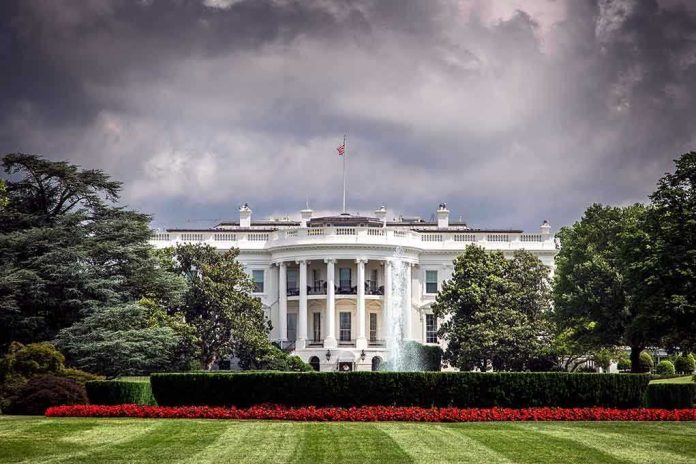
Reporters on the North Lawn heard multiple gunshots on a Saturday evening as Secret Service rushed the press corps into the White House, locking down the complex while agents moved to neutralize the threat.[1] Law enforcement sources identified the gunman as 21-year-old Nasire Best of Maryland, who approached an outer security checkpoint near 17th Street and Pennsylvania Avenue Northwest, pulled a firearm from a bag, and began firing at uniformed officers guarding the perimeter.[2] Officers returned fire, killing Best at the scene.[2]
Witness accounts and live video circulated quickly across television and social media, showing journalists ducking for cover and Secret Service agents fanning out with weapons drawn.[1] Initial reports describe a chaotic but disciplined response as agents hustled people behind cover, established a wider cordon, and moved President Trump to a secure posture inside the building.[2] Officials later confirmed that the president remained unharmed and that the lockdown was lifted after the immediate threat was contained and the area cleared.[2]
Who Was Nasire Best And Why Was He Near The White House Again?
Court records cited by national outlets show this was not Best’s first troubling encounter with the White House perimeter.[2] In June 2025, he reportedly blocked a White House entry lane, told agents he was Jesus Christ, and said he wanted to be arrested, leading authorities to order a mental evaluation.[2] The following month he was arrested again for unlawful entry and, after arraignment, was ordered by a judge to stay away from the White House complex entirely.[2]
Those same records show Best failed to appear for an August 7, 2025 status hearing, prompting a no-bond, Washington, D.C.–only bench warrant.[2] Despite that warrant and the prior stay-away order, he still managed to come back to the most heavily protected site in the country with a gun in his bag. For many Americans, that raises hard questions about how a documented repeat offender with apparent mental-health concerns slipped through the cracks of the local justice system and broader security net.[2]
Collateral Damage, Conflicting Details, And The Transparency Gap
Officials confirmed that a bystander was wounded during the exchange of gunfire, highlighting how quickly an attack on a symbolic target can put ordinary citizens in the line of fire.[2] CBS News reported that investigators had not yet determined whether the bystander was struck by rounds fired by Best or by return fire from officers, leaving an uncomfortable uncertainty about exactly how the injury occurred.[2] That open question matters for public trust, especially when families see yet another major incident playing out near a supposedly secure federal site.
Police say the suspected gunman in Saturday’s shooting at the White House was identified as 21-year-old Nasire Best. Court records show Best tried to gain entry to the White House last July, and was sent to a psychiatric ward for mental health issues. CBS News’ @NatalieABrand… pic.twitter.com/l255OdgvGb
— CBS Evening News with Tony Dokoupil (@CBSEveningNews) May 24, 2026
Key facts about the confrontation are still filtered through unnamed law-enforcement sources rather than a fully released incident report or ballistics file.[1][2] Outlets differ on whether Best used a revolver or pistol and how many shots were fired, underscoring how early narratives can harden before evidence is fully analyzed.[2] For conservatives who have watched politicized investigations and selective leaks for years, the reliance on anonymous sources, delayed forensic details, and partial court references feeds skepticism, even while they applaud agents for stopping a potential assassination attempt.[1][2]
Law And Order Under Trump Versus A System That Still Looks Broken
President Trump publicly praised the “swift and professional” actions of the Secret Service, reflecting his long-standing emphasis on law and order and strong protection for national institutions. From a security standpoint, the agents did what they are trained to do: respond immediately, neutralize the threat, and safeguard the president and those nearby.[2] Yet the deeper story is not only about a fast, justified response; it is about how a man already on the system’s radar, under a stay-away order, and subject to a bench warrant was free to walk back to the gates with a gun.[2]
Americans watching another incident at the White House cannot ignore the pattern: violent crime, untreated mental illness, and a justice system that often releases unstable offenders back onto the streets with little follow-up. While this case does not implicate gun owners who respect the Second Amendment, it does expose failures in enforcing existing laws and court orders, something conservatives have demanded for years. Until those failures are addressed openly and honestly, the country will keep seeing the same headlines and the same shaken reporters diving for cover near the very seat of our government.[1][2]
Sources:
[1] YouTube – US Secret Service Shot Down 21-Year-Old Gunman Nasire Best
[2] Web – Alleged gunman outside White House had previous run-ins with …