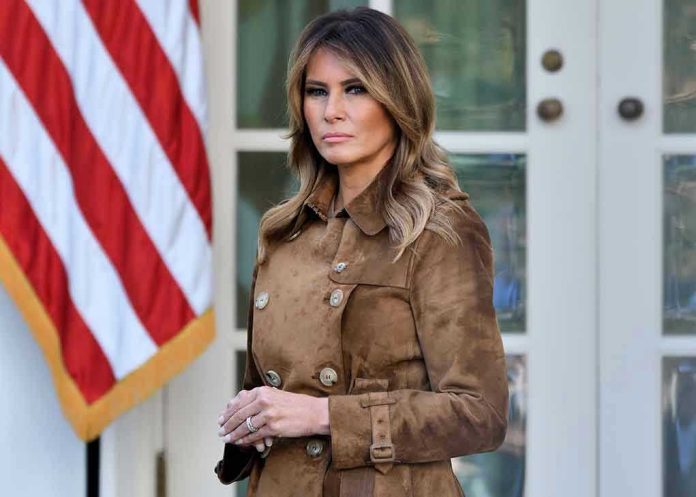
The world watched as eight Ukrainian children, ripped from war and swept into Russia, found their way back to their families—thanks to the unlikeliest of diplomatic architects: First Lady Melania Trump.
Story Highlights
- Melania Trump directly negotiated with Vladimir Putin for the children’s release.
- Months of secret backchannel diplomacy bridged the divide between warring nations.
- Joint U.S., Russian, and Ukrainian verification brought rare transparency to a humanitarian crisis.
- The reunification sets a precedent for future cross-border child welfare interventions during conflict.
Melania Trump’s Personal Diplomacy Breaks Through
Diplomacy rarely makes headlines for changing lives in real time, but when Melania Trump penned a letter to Vladimir Putin in August 2025, she set a chain of events in motion that would cut through layers of political ice. Delivered by President Donald Trump during a tense Alaska summit, the letter sidestepped official channels, signaling urgency and personal commitment. Melania’s outreach was not a ceremonial gesture—it was the opening move in a months-long negotiation targeting one of the Russia-Ukraine war’s most painful tragedies: the forced transfer of Ukrainian children into Russia, a crisis condemned globally and underscored by an International Criminal Court warrant for Putin himself.
While presidents and generals argued over borders, Melania Trump focused on the faces behind the headlines. Her approach upended usual protocol, leveraging her unique access to world leaders and her status as a mother. The White House confirmed that, in the weeks following the letter, Melania’s team maintained direct, confidential contact with Putin’s representatives, bypassing much of the bureaucratic inertia that typically stifles progress in international child welfare cases.
Verification, Secrecy, and a Rare Window of Trust
The reunification process was not a simple exchange. Ukrainian and Russian commissioners for children’s rights, typically adversaries, were forced into unlikely cooperation, jointly verifying children’s identities and circumstances. Russia provided rare access: biographies, photographs, and medical and psychological records for each of the eight children. These records were scrutinized by U.S. officials, who then confirmed the reunification’s authenticity. This level of transparency, set against the backdrop of ongoing war and mutual suspicion, is nearly unprecedented. The details of the children’s backgrounds remain shielded for privacy, but the essential facts—verified and announced publicly by Melania Trump on October 10, 2025—are confirmed across American, Ukrainian, and Russian government channels.
BREAKING: US First Lady Melania Trump announces President Putin responded to her letter about children impacted by the war in Ukraine.
She announces that eight children have been reunited with their families in the past 24 hours. https://t.co/G8gDzyqv3Q
📺 Sky 501 pic.twitter.com/IgTDMW5M32
— Sky News (@SkyNews) October 10, 2025
The timing and precision of the operation also raise the question: does this mark a new phase in wartime humanitarian action, or is it a singular breakthrough? The answer, so far, is open-ended. Plans are underway to reunite additional children, including those who have reached adulthood since their forced displacement. An open channel for further negotiation remains active, suggesting that the blueprint forged here could be scaled for future cases.
Humanitarian Impact and Political Calculus
Eight children are now home, but the ripples extend far beyond individual families. For Ukrainian parents and communities traumatized by abduction and displacement, this event delivers much-needed hope and the validation of their cause. For Russia, the willingness to cooperate—at least in this instance—offers a rare opportunity to counter accusations of intransigence and humanitarian neglect. The U.S. government, for its part, has seized on the event as proof that even in conflict, bridges can be built by focusing on shared human values.
Legal experts point to the joint verification process as a milestone, especially as it unfolds under the shadow of the ICC’s ongoing case against Putin. Humanitarian advocates stress the psychological importance for the children, who now receive support and care as they work to heal. Yet some observers warn against viewing this event as a panacea; the broader issue of forced transfers remains unresolved, and thousands of children are still separated from loved ones. The diplomatic machinery, once set in motion, now faces a test: can this precedent lead to sustained humanitarian engagement, or will it be remembered as an anomaly amidst ongoing hostilities?