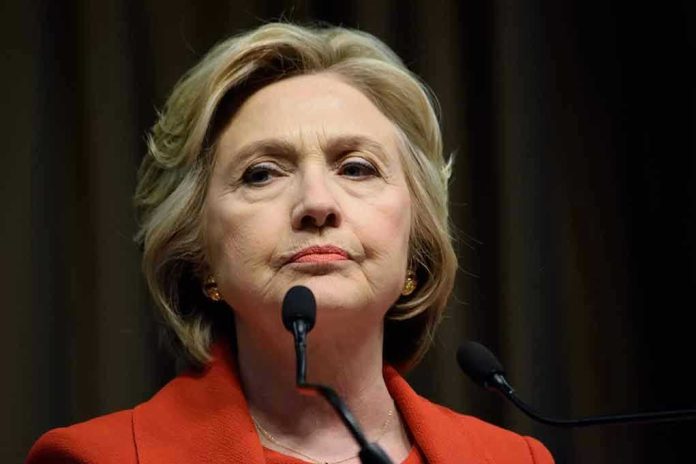
Hillary Clinton is back on the world stage—this time hosting a “girls’ rights” panel that put America’s gender-ideology culture war front and center.
Story Snapshot
- A Munich Security Conference panel on “fundamental rights” for girls and women featured Rep. Sarah McBride, the first openly transgender member of Congress.
- Clinton introduced McBride in supportive terms, while conservative media framed the appearance as a glaring contradiction in women’s-rights messaging.
- McBride attended despite a U.S. travel disruption tied to a partial government shutdown that canceled official congressional travel.
- The event highlights how global institutions increasingly blend security talk with domestic-style cultural and social policy battles.
Munich panel merges global security messaging with U.S. culture-war fights
The Munich Security Conference hosted a panel on February 14, 2026 titled “Girls Just Want to Have Fundamental Rights: Fighting the Global Pushback,” moderated by Hillary Clinton. Rep. Sarah McBride (D-Del.) appeared as a featured participant, an inclusion that set off sharply different reactions depending on political viewpoint. Reporting confirms the basic facts of the event—its timing, the venue, and the participant lineup—while the dispute centers on what “women’s rights” means in 2026.
Video from the session shows Clinton introducing McBride favorably, describing her as a “gender rights champion” and framing her work as part of a broader effort against coordinated political threats. The panel’s theme was not narrowly U.S.-focused; it emphasized international setbacks and organized pushback against rights claims, including changes in treaty participation and political campaigns to roll back protections. Even so, the optics of defining “girls’” and “women’s” rights while spotlighting a transgender lawmaker became the immediate flashpoint.
Shutdown-era travel confusion shows how Washington dysfunction bleeds into foreign events
One concrete detail that cut through the rhetoric was the travel backdrop. McBride’s office confirmed the lawmaker would still attend the Munich gathering even after official U.S. congressional travel was canceled in connection with a partial government shutdown linked to failed Department of Homeland Security funding negotiations. That distinction matters because it clarifies the event was not presented as an official congressional delegation under normal circumstances, even though a sitting member of Congress participated.
The travel wrinkle also underlines how Washington dysfunction can spill into international forums: when normal appropriations and funding talks fail, even routine diplomatic and policy engagement becomes improvisational. For voters who prioritize competent governance and limited, accountable government, shutdown-driven disruption is not just a headline—it changes how America’s representatives show up abroad, who funds the logistics, and how foreign audiences interpret U.S. political stability. Available reporting does not provide full details on the funding or arrangements for independent attendance.
Who McBride is, and why the “women’s rights” framing triggers backlash
McBride’s prominence is rooted in biography and electoral history, not just a single panel appearance. Profiles describe McBride as the first openly transgender member of Congress, elected in 2024 to represent Delaware statewide, and as a longtime activist and speaker within Democratic politics. Coverage also notes McBride’s legislative priorities since entering Congress have included bills connected to reproductive policy, medical privacy, and access questions—issues frequently bundled under modern “rights” messaging in progressive coalitions.
Conservative criticism of the Munich event largely follows a familiar pattern: critics argue that inserting gender-identity politics into women’s-rights spaces confuses or dilutes sex-based categories central to many policy debates, including sports, privacy, and single-sex protections. The research provided reflects that the harshest language came from partisan commentary rather than neutral reporting. What can be stated as fact is simpler: the same panel was framed by supporters as inclusive advocacy and by opponents as a contradiction—proof that definitions, not just policies, are now contested terrain.
What the episode signals for Americans watching global institutions
Munich is primarily known as a security forum, yet this panel illustrates how modern “security” conversations often expand into social policy, health policy, and cultural narratives. Panelists discussed international efforts and networks aimed at countering rights “pushback,” and the conversation referenced coordinated campaigns and political messaging battles. That blend is exactly what frustrates many Americans who want foreign-policy venues to focus on defense, sovereignty, and strategic threats rather than exporting ideological disputes across borders.
OUTRAGE! Hillary Clinton Hosts Panel on “Fundamental Rights For Women” – and Her First Guest is a Man Pretending to be a Woman: Trans Rep. “Sarah” McBride (VIDEO) https://t.co/vn2iSYd7nn
— The Gateway Pundit (@gatewaypundit) February 14, 2026
For conservative readers, the main takeaway is not that a panel happened—global conferences host panels constantly—but that high-profile U.S. figures continue to use international platforms to advance contested social frameworks that remain divisive at home. The available sources do not document any direct policy changes resulting from the session, nor do they show bipartisan agreement on the panel’s framing. What they do show is a clear snapshot of where the debate sits: Democrats elevating gender-identity-based advocacy under women’s-rights banners, and conservatives rejecting that redefinition as incoherent.
Sources:
Transgender lawmaker Sarah McBride joins Hillary Clinton at girls rights forum
Delaware’s Sarah McBride and the path to Congress after the 2024 election
The First Transgender Member of Congress, Sarah McBride