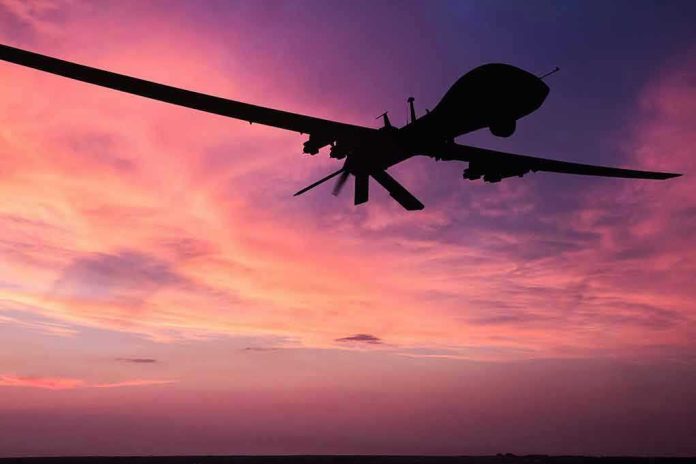
President Trump’s controversial drone strike on an alleged drug vessel has ignited fierce debate over executive authority and constitutional limits on military force, with critics calling it extrajudicial killing while supporters defend it as necessary border protection.
Story Highlights
- Trump authorized drone strike on suspected drug trafficking vessel, justifying action as “self-defense”
- Legal experts question constitutional authority for lethal force without imminent threat to American lives
- Critics argue strike resembles extrajudicial execution rather than legitimate defensive action
- Incident raises broader concerns about presidential war powers and due process protections
Presidential Authorization Under Fire
President Trump authorized a drone strike targeting what administration officials described as a drug trafficking vessel, defending the lethal action as necessary “self-defense” against threats to American security. The strike, conducted without traditional judicial oversight or congressional authorization, has drawn sharp criticism from constitutional scholars who argue the administration exceeded legal boundaries. Trump’s justification centers on protecting American borders from drug cartels, but critics contend the circumstances fail to meet established legal standards for defensive military action.
Constitutional Concerns Over Due Process
Legal analysts argue the drone strike violates fundamental due process protections guaranteed by the Constitution, particularly the Fifth Amendment’s requirement that no person be “deprived of life, liberty, or property, without due process of law.” The administration’s broad interpretation of self-defense powers concerns constitutional conservatives who traditionally oppose executive overreach. Critics note the strike occurred without imminent threat to American lives, a key legal requirement for justified lethal force. This erosion of constitutional safeguards sets dangerous precedents that could undermine individual liberty protections.
The incident highlights tensions between aggressive border security measures and constitutional limitations on government power. While conservatives support strong border enforcement, many express unease about bypassing traditional legal processes. The strike’s targeting of suspected rather than confirmed threats raises additional due process questions. Constitutional scholars warn such actions could normalize extrajudicial killings, fundamentally altering America’s legal framework.
Precedent and Military Authority Questions
The strike draws comparisons to previous controversial military actions, including the 2020 assassination of Iranian General Qasem Soleimani, which also sparked debate over presidential war powers. Military legal experts question whether drug interdiction falls within traditional self-defense doctrines that typically require imminent physical threats to American personnel or territory. The administration’s expansive interpretation of defensive authority could enable future presidents to justify similar actions against various perceived threats.
Political and Legal Ramifications
Conservative legal scholars face a dilemma between supporting Trump’s tough-on-crime approach and defending constitutional principles that limit government power. The incident threatens to divide the conservative base between those prioritizing border security and constitutional purists concerned about executive overreach. Opposition voices argue the strike represents dangerous erosion of legal protections that could eventually threaten all Americans’ rights. The controversy underscores ongoing tensions over balancing security concerns with constitutional limitations on federal power.
This incident serves as a critical test for conservative commitment to constitutional principles versus support for aggressive enforcement measures. Patriots must remain vigilant against any expansion of government power that circumvents constitutional protections, regardless of the stated justification.
Sources:
List of presidential trips made by Donald Trump (2025)
President Trump hosts a dinner Sep 5 2025
President Trump makes an announcement Sep 2 2025