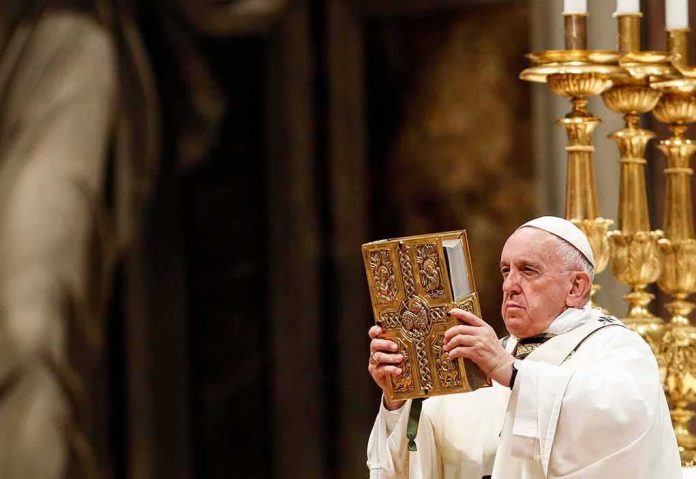
Pope Leo XIV told the world he has a small, localized lung nodule and chose surgery to remove it.
Story Snapshot
- The Pope announced a localized lung nodule found during routine checks.
- He said he will undergo surgery to remove the nodule in the coming days.
- Vatican officials expect about a week of postoperative hospitalization.
- Gemelli Hospital in Rome was identified as the surgical site.
The Pope’s Plainspoken Announcement And Plan
Pope Leo XIV briefed the faithful in St. Peter’s Square. He said doctors found a small, well-contained nodule in his lung during recent checks. He explained that physicians advised intervention and that he chose surgery to remove it. Vatican News reported that the plan is removal, not only testing, and that the condition was caught early. His statement set a calm tone. He asked for prayers and framed the step as a prudent act, not a crisis.
The Holy See Press Office reinforced the timeline. Officials said the operation is slated for the first days of the week and recovery should require about a week in the hospital. Reports identified Rome’s Gemelli Hospital as the site, a familiar setting for papal care. No exact date or lesion size was disclosed, and no pathology result exists yet, because removal has not occurred. That restraint matches standard medical privacy and timing.
What “Localized Nodule” Means For Risk And Recovery
Doctors use “nodule” for a small spot in the lung seen on imaging. Many nodules are benign scars, infections, or other noncancer causes. Some are malignant. The best way to know is tissue analysis after removal. Guidance from thoracic surgery groups stresses that treatment choices should rely on histology and that minimally invasive approaches are preferred when surgery is needed. Early, localized findings often allow targeted surgery and faster recovery, which matches the one‑week estimate.
Public response followed a familiar pattern when a major figure reveals a health step. Research on celebrity health disclosures shows these moments can drive people to seek information and even medical checks, for better or worse. The benefit comes when the message is clear and responsible. The risk arrives when rumor fills gaps. The Vatican’s messaging stuck to direct facts and avoided speculation on diagnosis. That approach respects prudence and personal dignity while keeping the public informed.
Why The Setting And Tone Matter
The announcement came during the Angelus, where popes usually teach and pray with the crowd. By choosing that moment, the Pope treated the news as part of pastoral life, not a palace bulletin. The words were simple: early, localized, removal planned. That clarity helps the faithful hold to prayer, not panic. It also continues a recent shift in papal health communication toward greater openness, away from the deep secrecy that shaped earlier eras.
Pope Leo XIV has announced he will undergo surgery to remove a lung nodule discovered during recent medical examinations.https://t.co/MLW4S5gpUA
— News Central TV (@NewsCentralTV) October 11, 2026
Modern coverage of papal health often brings instant global attention. That speed can blur lines between facts and guesses. Responsible reporting should keep tight to what is known: a localized nodule, a planned removal at Gemelli, and an expected short stay. Anything beyond that needs proof from the operating room and the laboratory. Until then, common sense says do not leap ahead of the doctors. Let the surgery and the pathology speak when they exist.
What To Watch Next
Three updates will close the loop. First, a Vatican bulletin confirming the operation took place and naming the procedure. Second, the initial postoperative status report from Gemelli. Third, a pathology result that defines the nodule’s nature and whether any further treatment is needed. If the timeline holds, those notes should arrive within days of surgery and in the week after discharge. Each step will replace guesses with facts, which is how medicine should proceed.
Sources:
youtube.com, vaticannews.va, bbc.co.uk, abcnews.com, cbcpnews.net, link.springer.com, academic.oup.com, repository.uantwerpen.be