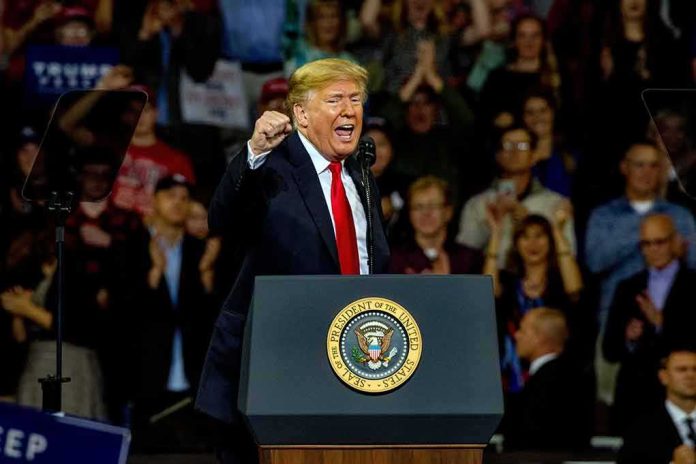
President Trump signed an executive order to open tax-free dyed diesel for highway use and defer the federal diesel tax through year-end, delivering fast relief for truckers and farmers.
Story Highlights
- Trump signed the order on stage at a Nebraska rally, expanding access to tax-exempt dyed diesel.
- White House says highway use of dyed diesel is temporarily allowed and federal diesel tax is deferred.
- USDA estimates about $640 million in combined savings across U.S. agriculture.
- Red-dyed diesel is the same fuel as regular diesel, historically restricted to off-road use.
What President Trump Ordered And When
President Trump signed the order on Monday during a rally in Grand Island, Nebraska. The White House said the policy allows temporary highway use of tax-free dyed diesel and directs the Treasury Department to defer the federal excise tax on dyed diesel for the rest of the year without interest or penalties. Reuters and other outlets reported the signing and described the move as expanding access to tax-exempt diesel for drivers beyond off-road users.
The action targets high fuel costs that hit truckers, farmers, and families. The White House framed it as immediate relief for those who move food and goods, arguing lower diesel costs can ease prices across the supply chain. Agriculture leaders in the administration praised the move. The United States Department of Agriculture said lifting taxes tied to dyed diesel would support farmers and ranchers who have faced rising fuel costs during harvest and transport seasons.
How Dyed Diesel Works And Why It Matters
Red-dyed diesel is chemically the same as regular diesel but is marked with a red dye to signal tax status. It has long been used in agriculture and construction and is typically exempt from highway fuel taxes. Federal enforcement has barred its use on public roads because those taxes fund highways. Under the order, dyed diesel can be used on highways for now, and the federal excise tax payment is deferred, which lowers the price at the pump for qualified buyers.
The White House said Treasury will also look at ways to eliminate payment of deferred taxes where the law allows. That step could turn a near-term deferral into lasting savings if agencies find lawful paths. Media reports quoted President Trump saying the change would save the typical trucker more than one hundred dollars per fill-up, and that those savings could ease the cost of groceries and goods as fuel costs flow through freight rates.
Who Stands To Benefit And By How Much
Truck drivers who fuel often, farmers who run diesel equipment, and small businesses that rely on diesel vehicles should see the most direct relief. The United States Department of Agriculture estimated the action could represent about six hundred forty million dollars in combined federal and state savings across roughly two hundred twenty-four point six million harvested acres. That figure points to broad impact across farm states, where fuel is a major input cost for planting, harvest, and transport to market.
I read this morning that using red-dye diesel will save about 24 cents a gallon 🤬🤬🤬🤬🤬🤬🤬🤬
Trump signs executive order to slash diesel costs as fuel crisis threatens to send US prices soaring https://t.co/XqL8wdU0Rx— [email protected] (@BilyHoliday) October 6, 2026
Shippers and retailers may also benefit if freight costs fall. However, the exact pass-through to store shelves depends on contract timing, local markets, and state policies. Some coverage flagged that effects on broader retail diesel prices could be modest without deeper market shifts. Still, letting the same fuel be used with the tax deferred cuts a known cost line today, and that is why drivers and producers pressed for this common-sense relief.
Important Limits And Implementation Details
The White House fact sheet lays out the core mechanics but does not replace state laws or every enforcement rule. The administration says federal and state agencies can use enforcement discretion as the policy takes hold. Because dyed diesel policy has long tied to highway tax rules, states that rely on fuel taxes for road funds may issue guidance on inspections and compliance. The federal order sets the direction; agency guidance will drive day-to-day application on roads and at terminals.
Before this order, federal materials warned drivers that using dyed diesel on highways could trigger steep penalties. The Internal Revenue Service explained that dyed fuel in highway vehicles was broadly prohibited and carried fines per violation. That is why the President’s order matters: it changes access and defers the federal tax for the stated period, aiming to ease costs for the people who grow, haul, and deliver America’s goods while agencies align practical rules to fit the new policy.
Sources:
nypost.com, whitehouse.gov, reuters.com, nytimes.com, cnn.com, usatoday.com, whio.com, 1011now.com, case-law.vlex.com