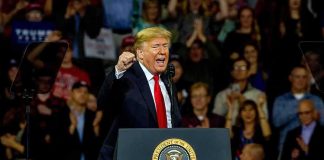
President Trump declared the United States in an active armed conflict with drug cartels, authorizing military forces to kill suspected cartel members without trial—a seismic shift that transforms drug enforcement into warfare.
Story Snapshot
- Trump issued a classified October 2025 memo declaring a “non-international armed conflict” with drug cartels, designating members as unlawful combatants subject to lethal military action without judicial process.
- Operation Southern Spear launched airstrikes in the Caribbean and Eastern Pacific starting September 2025, killing 11 in the first Venezuelan boat strike while claiming sea smuggling dropped 97 percent.
- The declaration invokes post-9/11 precedents used against al-Qaeda but bypasses Congressional authorization, sparking legal debates over executive war powers and due process.
- No specific cartels are named in targeting criteria, and the administration has provided no public evidence linking struck vessels to cartel operations, raising questions about sovereignty violations and potential escalation into Mexico.
From Border Policy to Battlefield Doctrine
The fentanyl crisis claimed over 100,000 American lives annually, creating political pressure for drastic action. Trump’s second term shifted from traditional law enforcement to military engagement, deploying Navy warships to the Caribbean in mid-August 2025. By September, airstrikes commenced against vessels allegedly tied to Venezuelan and Colombian narcoterrorist groups like Tren de Aragua and the National Liberation Army. The first strike killed 11 people aboard a boat Trump labeled a cartel vessel in a video release, marking the transition from interdiction to combat operations under Defense Secretary Pete Hegseth’s authorization.
The October 2025 memo to Congress formalized what military actions had already begun. Unlike the War on Drugs dating to Nixon’s 1970s policies or even Bush-era terrorist designations, this declaration asserts ongoing armed conflict status. It permits killing individuals deemed cartel combatants anywhere operations extend, without requiring imminent threat standards that govern typical law enforcement. White House Press Secretary Karoline Leavitt defended the policy in December 2025, stating the administration holds clear authority to eliminate narcoterrorists threatening American communities with drugs and violence.
Legal Foundations Built on Uncertain Ground
The unlawful combatant framework originated in Bush’s post-9/11 fight against al-Qaeda, validated partially in Hamdi v. Rumsfeld. That conflict had Congressional authorization through the Authorization for Use of Military Force and responded to direct attacks on U.S. soil. Trump’s cartel war lacks both elements. International law permits non-international armed conflicts under Geneva Conventions, but legal scholars note cartels have launched no equivalent to September 11th. The designation enables indefinite detention and targeted killings of suspects who may pose no immediate danger, a sharp departure from criminal justice standards requiring evidence and trial.
Critics argue the administration provides no transparent targeting criteria or named cartel organizations, creating legal ambiguity about who qualifies as a combatant. The Pentagon briefed Congress on kinetic operations but sought no legislative approval, bypassing the constitutional war powers debate. Democrats raised sovereignty concerns after Mexico and Venezuela protested strikes, while some Republicans supported aggressive action against groups profiting from a $100 billion drug trade. The framework mirrors Obama-era drone strikes against terrorists overseas, yet cartels operate across borders where American allies govern, complicating jurisdictional questions that remain unresolved in ongoing operations.
Strategic Results and Mounting Risks
Operation Southern Spear reports dramatic reductions in maritime smuggling, with administration officials claiming a 97 percent drop in sea-based cartel activity through naval interdictions and airstrikes. Domestic raids in locations like Los Angeles’s MacArthur Park complement offshore operations, targeting cartel distribution networks within U.S. cities. Disrupting billion-dollar smuggling routes imposes financial pressure on organizations like Sinaloa and CJNG cartels, though no public evidence confirms which specific groups were struck. Short-term tactical gains appear measurable if official statistics hold under independent scrutiny, though verification remains limited given classified operational details.
Long-term consequences loom larger than immediate successes. Trump threatened ground operations in Mexico if cooperation fails, raising prospects of regional military conflict that could destabilize Latin America. Precedent now exists for presidents to declare armed conflicts unilaterally against non-state criminal organizations without Congressional oversight or geographic limits. Cartels command paramilitary forces and corruption networks across multiple nations, meaning military escalation could spawn retaliatory terrorism rather than surrender. Economic disruption extends beyond cartels to Mexican tourism and regional stability, while strained diplomatic relations with allies question whether aggressive unilateralism serves national security better than cooperative law enforcement. The shift from prosecuting drug traffickers to killing combatants fundamentally alters counternarcotics strategy with implications extending far beyond current operations.
Sources:
Trump Declares ‘Armed Conflict’ Against Cartels – Council on Foreign Relations
United States strikes on alleged drug traffickers during Operation Southern Spear – Wikipedia