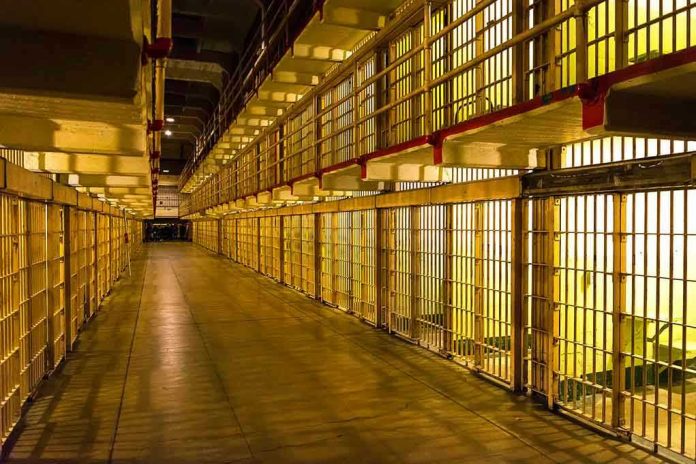
Trump’s plan to turn Alcatraz from a tourist attraction back into a federal prison is now colliding with a hard question conservatives can’t dodge: are we getting real “law and order,” or just another expensive Washington symbol paid for by taxpayers?
Story Snapshot
- The White House FY2027 budget request includes $152 million to start rebuilding Alcatraz into a modern high-security prison.
- The administration’s proposal follows President Trump’s earlier directive to reopen and expand Alcatraz for “ruthless and violent offenders.”
- Congress has not approved the request, and the budget language is described as a non-binding proposal.
- Estimated total costs have been floated around roughly $2 billion, reviving concerns that Alcatraz was historically shut down for extreme operating expenses.
$152 Million Request Puts Alcatraz Back on Washington’s Agenda
The White House included a $152 million request in its fiscal year 2027 budget proposal to begin rebuilding Alcatraz Island into what it describes as a “state-of-the-art secure prison” for America’s most violent offenders. The facility has long been operated as a National Park Service site and major tourist destination in San Francisco Bay. The administration’s move formalizes an idea President Trump previously promoted publicly, but it still requires congressional approval before any construction begins.
https://www.youtube.com/post/UgkxQk-kOl-W4YNDSfQ8b2l3SoJmhnY82Ua7
The timing matters politically. A budget request signals executive intent, but it does not guarantee Congress will authorize the money or the project. The proposal is being treated as a suggestion that appropriators can accept, reshape, or reject. That reality creates an immediate test for fiscal conservatives who want violent criminals locked up securely, but also want federal spending disciplined and transparent—especially when early estimates suggest the full rebuild could cost far more than the first-year request.
Why Alcatraz Was Closed Before—and Why That History Still Matters
Alcatraz operated as a federal penitentiary from 1934 to 1963 and built its reputation as an extremely secure facility due to its island location, cold waters, and strong currents. The prison was ultimately shuttered and later closed as a federal facility in 1969, with cost cited as a major factor—often described as multiple times more expensive than other prisons. After that era, the site shifted under National Park Service control and became a high-profile tourism destination.
That history is more than trivia because the same cost pressures could reappear in a modern rebuild. High-security incarceration demands staffing, transport, maintenance, and hardened infrastructure, and an island location complicates all of it. The administration has not provided, in the materials summarized in the research, a detailed public breakdown showing how a rebuilt Alcatraz would avoid the operating-cost trap that ended the original prison. Without that, budget hawks will likely ask for specifics before writing a blank check.
What Trump Directed, What the Budget Proposes, and What Congress Controls
President Trump previously directed the Bureau of Prisons and the Justice Department to “reopen a substantially enlarged and rebuilt ALCATRAZ” for violent offenders, aligning the concept with a broader tough-on-crime message. The FY2027 budget request turns that directive into a concrete first-year funding ask. Still, Congress holds the power of the purse, and the project’s future will depend on appropriations, oversight conditions, and whether lawmakers view the proposal as practical compared with other prison-capacity options.
The interagency friction is built in. The Bureau of Prisons would be responsible for implementing a prison project, while the National Park Service currently runs Alcatraz as a public attraction. Any serious conversion would likely require a transfer of control and a reshaping of the site’s public mission. Local economic stakeholders tied to tourism could resist, and legislators could demand proof that the project improves capacity or security more efficiently than expanding existing federal facilities on the mainland.
Political Blowback and the Bigger Question for Conservatives
Democratic criticism has already been blunt. Former House Speaker Nancy Pelosi, a prominent San Francisco lawmaker, publicly mocked the idea as Trump’s “stupidest initiative yet,” reflecting the political intensity around repurposing a famous Bay Area landmark. The proposal also highlights a recurring tension in conservative politics: voters want consequences for violent criminals, but they also distrust expensive federal projects that become permanent cost centers. The argument will likely turn on hard numbers and measurable outcomes.
For a right-leaning audience burned by years of wasteful spending, the most important issue is whether this is a targeted public-safety investment or a symbolic project that grows into a multi-billion-dollar commitment. The available reporting confirms the $152 million request and the broader concept, but it offers limited detail on operating costs, timelines, or how Congress would structure oversight. Until those specifics are public, skepticism is rational—even among voters who agree with the law-and-order goal.
Congressional review will decide whether Alcatraz becomes a national tough-on-crime showpiece or remains what it is today: a historic site run by the Park Service. If lawmakers move forward, the decision should come with clear constitutional guardrails and strict fiscal conditions—because conservatives are not just demanding safer streets, they are demanding competence, accountability, and an end to government projects that balloon far beyond their original promises.
Sources:
Trump requested $152 million to rebuild Alcatraz prison closed in 1969
Trump seeks $152 million to reopen Alcatraz as active prison