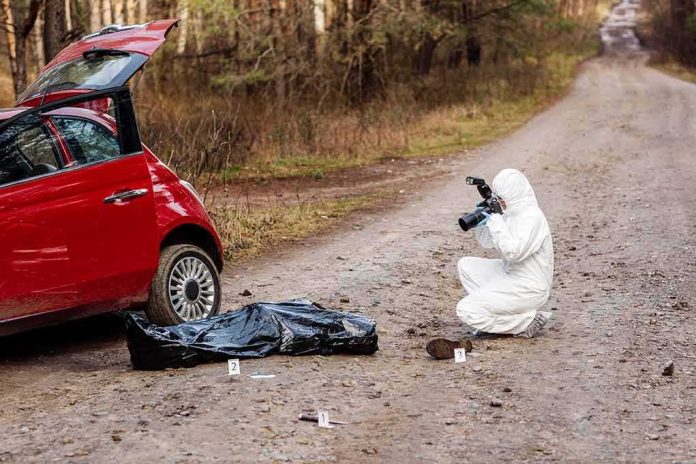
A Los Alamos National Laboratory employee vanished and was later found dead with a handgun nearby, and officials still have not said how or why she died, keeping hard questions open.
Story Snapshot
- State police identified the remains of Los Alamos National Laboratory employee Melissa Casias; the investigation is ongoing [6].
- A handgun was found near the remains, but no official cause or manner of death has been released [6].
- Reports say the recovery site sits near where she was last seen, narrowing the timeline but not the explanation [2].
- Media have linked her case to other missing scientists without confirmed investigative ties, risking speculation [2].
What Authorities Have Confirmed So Far
New Mexico State Police announced that human remains discovered in the Carson National Forest were identified as those of Los Alamos National Laboratory employee Melissa Casias, and that the investigation continues. Reporting says a handgun was located near the remains, a concrete scene detail that raises, but does not resolve, questions about suicide, homicide, accident, or staging. The Office of the Medical Investigator has not released the cause or manner of death, leaving key facts undetermined [6].
Local reports reinforce the unresolved status. Broadcast segments summarizing statements from state police note that investigators are still working the case and that the firearm’s presence alone cannot establish what happened. Coverage also warns against premature conclusions while acknowledging the public’s demand for clarity. This posture signals an active, meticulous inquiry but underscores that the public record lacks autopsy, toxicology, and ballistic findings at this stage [2].
Where The Case Was Found And Why Location Matters
Reports say the remains were recovered in the McGaffey Ridge area of the Carson National Forest near Taos, close to where Casias was reportedly last seen. That geographic detail focuses attention on the initial disappearance route and search coverage, suggesting a local, case-specific trajectory rather than a confirmed broader pattern. Without officially released search logs and recovery chronologies, however, the public cannot verify whether earlier searches missed the site, conditions changed, or other factors complicated discovery [2].
Some coverage has indicated that areas previously searched figure into the timeline and that family members intend to keep pursuing answers, but it still does not supply agency search-grid maps, incident logs, or environmental analyses that would explain the discovery gap. Until those operational records or a forensic reconstruction are public, the location supports investigation continuity, not a settled narrative about how the remains came to be there when found [6].
Sorting Facts From Speculation In National-Security Adjacent Cases
Media framing has highlighted other missing or deceased individuals linked to national-security work, yet the same reports acknowledge there are no confirmed investigative links to Casias’s death. That juxtaposition can inflate the appearance of a pattern before the forensic record is complete. Responsible scrutiny concentrates on what is documented: identification by state police, a handgun at the scene, and no declared cause or manner of death from the medical examiner to date [2].
Remains of missing nuclear scientist Melissa Casias, who worked at the Los Alamos National Laboratory, have been found in New Mexico, nearly 11 months after she disappeared.
“When Casias vanished nearly a year ago, her family discovered that her personal belongings, including… pic.twitter.com/ZqkSf3tjjX
— Ben Swann (@BenSwann_) June 2, 2026
Conservative readers should demand transparency from institutions without leaping past the evidence. Officials can help by releasing, when appropriate, the autopsy and toxicology results, firearm forensics, search-operation records, and digital evidence logs. Those materials would clarify whether the handgun was fired or handled by Casias, whether environmental factors delayed recovery, and whether any workplace-related issues were examined and ruled in or out. Until then, common sense says treat ambiguity as a reason for patience, not presumption [6].
Sources:
[2] Web – Deaths in Los Alamos During the Manhattan Project
[6] YouTube – Missing scientists: Body of national lab employee found, police say