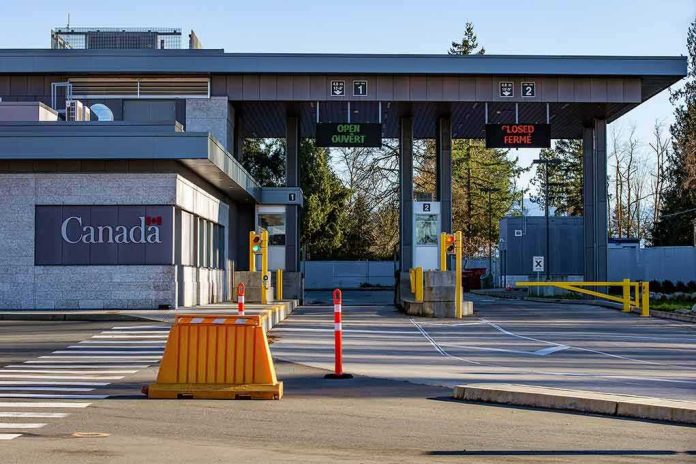
President Trump paused a planned 50% tariff hit on Canadian goods for three days after both countries said a deal was at hand.
Story Snapshot
- Trump announced a three-day pause on 50% tariffs tied to a pending U.S.-Canada deal.
- The pause came just before the tariffs were set to start, affecting about $20 billion in imports.
- Canada said talks were intensive and ongoing, with progress but work left to do.
- The pause is conditional on final documents, leaving exact terms undisclosed.
What Changed: A Last-Minute Tariff Pause
On August 18, President Trump said he paused new 50% tariffs on Canadian goods for three days and tied the pause to a pending deal between the two countries. The action landed just before the tariffs were due to start midweek, which would have raised costs on a wide set of products. The Associated Press reported the scope at about $20 billion in imports that would have faced higher charges if no pause occurred. Trump said the pause depends on final papers getting signed.
Canadian leaders and trade officials confirmed heavy talks leading into the deadline. Global Affairs Canada said Minister Dominic LeBlanc and Chief Negotiator Janice Charette briefed provincial and territorial trade ministers and were engaging intensively with the United States ahead of the cutoff. Reuters reported LeBlanc met with United States trade officials three times in three weeks before the pause and pledged to stay at the table. The timeline shows both sides working under pressure.
How We Got Here: Leverage, Pressure, and a Tight Clock
Trump’s team has used tariff threats as leverage to push partners toward faster deals, often right up to deadlines. In this case, reporting described talks over sensitive areas such as autos, dairy, and alcohol, though details remain thin and rely on unnamed sources. Canada’s public stance was careful. Officials acknowledged “substantial progress” while noting more work remained, which signals momentum without confirming final terms. That balance kept talks alive while markets and firms waited for clarity on costs.
The pause did not erase uncertainty. Trump linked the delay to document finalization, which means the relief can vanish if papers do not close on time. Reuters framed the move as a three-day window before tariffs would otherwise kick in. The narrow runway can unsettle importers, shippers, and small manufacturers who plan orders months ahead. When tariff risk spikes, businesses hesitate on hiring and investment, and prices can swing as firms try to hedge exposure to sudden cost jumps.
Why It Matters for Americans and Canadians
For families, a 50% tariff can raise prices on everyday items that cross the border several times before reaching shelves. For small businesses, a sudden cost surge can wipe out thin margins. For farmers and factory workers, retaliation from Canada would hit sales and jobs. The reported $20 billion trade slice is large enough to ripple through supply chains on both sides of the border if the pause lapses or narrows after the three-day window.
For years, both parties have watched trade fights turn into cliffhangers. The pattern rewards speed and headlines over clear, stable rules. Conservatives worry about global deals that ignore American workers. Liberals worry about power deals that widen the gap between winners and losers. Both sides see a federal system that often plays brinkmanship with people’s paychecks. This pause, and the rush around it, fits that concern: big moves first, details later, and regular people left to cope in between.
What to Watch Next: Paper, Product Lists, and Real-World Impact
Final documents will show what each side agreed to, and how the pause converts into policy. A United States implementing notice or a United States Customs and Border Protection instruction would confirm what importers actually pay at the border. Canada’s releases could outline any concessions that match the sectors discussed in recent reports. Until then, firms should track guidance from border agencies and plan for either outcome when the three-day clock runs out.
Sources:
reuters.com, marketscreener.com, anewz.tv, apnews.com, ground.news, canada.ca