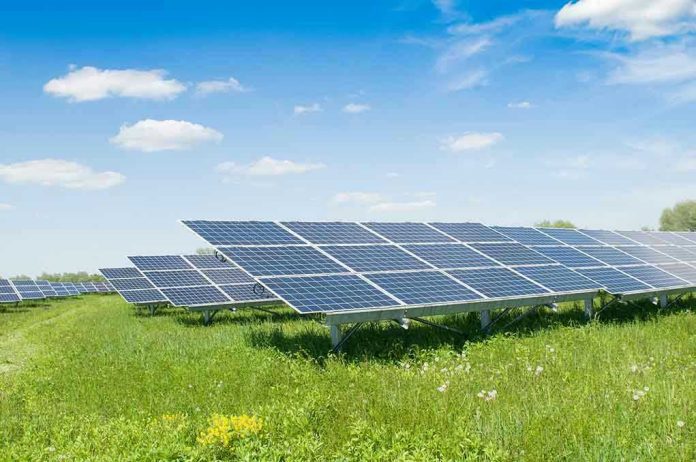
On July 4, 2025, Washington quietly rewired America’s energy future by slashing support for solar and wind while tightening control over who gets paid to power the grid.
Story Snapshot
- The One Big Beautiful Bill Act cuts key clean energy tax credits and accelerates their phaseout.
- New rules block tax benefits for projects tied to “foreign entities of concern,” including China.
- A follow-up executive order orders agencies to end policies favoring wind and solar over fossil fuels.
- Critics say the changes deepen a fossil fuel tilt and raise costs for everyday consumers.
What the July 4 bill actually does to solar and wind
On July 4, 2025, President Donald Trump signed the One Big Beautiful Bill Act (OBBBA) into law, reshaping federal support for clean energy. The law sharply rolls back technology-neutral tax credits created under the Inflation Reduction Act, especially the clean electricity production credit (section 45Y) and clean electricity investment credit (section 48E) for wind and solar projects. After 2027, wind and solar facilities placed in service can no longer claim these credits unless construction began by July 4, 2026, creating a hard deadline that pushes projects into a short rush window.
Law firms tracking the bill explain that, in effect, federal tax credits for most new wind and solar projects end after 2027. To qualify, developers now must either start building by July 4, 2026 or have their projects operating by December 31, 2027. If they miss both dates, they get no credit at all. That change injects major uncertainty into long, complex projects like large solar farms and offshore wind, which often need many years to move from planning to operation.
New foreign-supply rules and the push against “green” preferences
The Act also adds a new barrier tied to national security concerns. Starting in 2026, projects lose tax credits entirely if they are owned, controlled by, or receive “material assistance” from a prohibited foreign entity, such as certain Chinese or other flagged companies. Legal analyses note that these “foreign entity of concern” rules are complex and reach beyond direct ownership to supply chains and financing, but many details still need Treasury guidance. That leaves developers guessing how much Chinese or other foreign content could quietly disqualify a project.
Three days after signing the bill, Trump issued an executive order titled “Ending Market Distorting Subsidies for Unreliable, Foreign-Controlled Energy Sources.” The order directs the Treasury Department to “strictly enforce” the termination of wind and solar tax credits, including tightening what counts as “beginning of construction” so companies cannot lock in subsidies with only paper progress. It also tells the Interior Department to review and remove any regulations or policies that give wind and solar better treatment than “dispatchable” sources like gas or coal plants. In plain terms, the federal government is ordered to stop tilting the playing field toward renewables.
How this fits long-running energy fights and public frustration
Policy researchers note that fights over energy subsidies have cycled for decades, swinging between support for “energy dominance” through fossil fuels and pushes to speed a clean energy transition. Both parties have used tax credits, cheap leases, and other tools to reward their favored industries, from oil and gas in earlier eras to wind and solar under recent Democratic control. The One Big Beautiful Bill Act marks a clear move back toward fossil fuels, even as it claims to correct “market distortions” and protect taxpayers from paying for “expensive and unreliable” green power.
Studies on energy subsidy reform warn that sudden changes without clear communication often hit regular people hardest, through higher bills or slower investment in new supply. Many Americans already feel the federal government rigs markets for well-connected companies, whether oil majors or big renewable developers. Cutting solar and wind credits while leaving large fossil fuel support in place feeds the view on both left and right that “energy policy” is just another arena where elites pick winners and losers and ordinary families pay the price.
What it could mean for prices, reliability, and the “deep state” debate
Supporters of the bill argue that ending wind and solar subsidies will save the grid by pushing money back toward steady, dispatchable power that can run any time, in any weather. They say green subsidies have “looted” revenue from reliable plants, risking blackouts. Critics counter that global research shows total energy subsidies, especially for fossil fuels, are huge economic distortions that often help the powerful more than the poor. They worry the United States is locking in older fuels while other countries build cheaper clean systems.
Rep. Ted Lieu criticized the Trump administration after Energy Secretary Chris Wright announced an end to subsidies for new wind and solar projects. Lieu argued the move would reduce energy supply and raise costs for Americans, warning voters ahead of November. pic.twitter.com/Oc7VNVenxT
— DYK Todays (@DYKTODAYS) July 3, 2026
Independent reporting also finds that hundreds of renewable projects across many states already face delays or blocks from permitting fights and local or political opposition. Adding tighter timelines, foreign-content rules, and agency directives against “preferential treatment” could deepen that blockade. For conservatives angry at past “green” favoritism, this looks like long-awaited payback. For liberals furious about fossil fuel power, it feels like another giveaway. For a growing middle, it is more evidence that energy rules are written by and for the “deep state” of corporate lobbyists and career officials, not for families trying to keep the lights on at a fair price.
Sources:
utilitydive.com, reuters.com, canarymedia.com, nytimes.com, solar.com, earth.org, hks.harvard.edu, actonclimate.com, youtube.com, alexepstein.substack.com