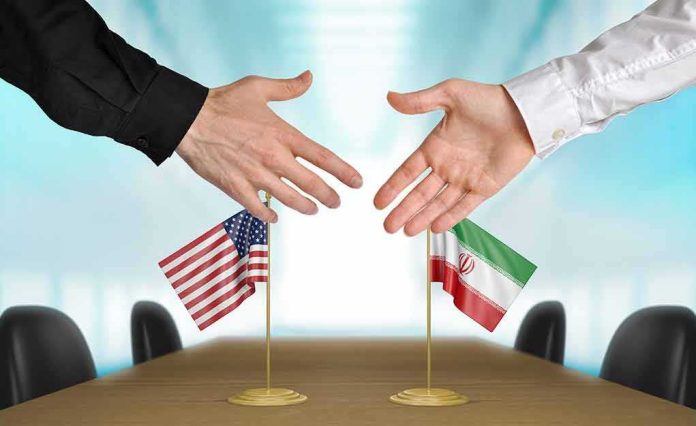
The United States and Iran are set to meet again in Pakistan on July 11 — but the last time they sat down there, they talked for 21 hours and walked away with nothing.
Story Snapshot
- A new round of U.S.-Iran talks is confirmed for July 11 in Pakistan, focused on sanctions, frozen assets, and nuclear issues.
- The April talks in Islamabad lasted 21 hours but ended without a deal, and the same core disputes remain unresolved.
- Iran wants full sanctions relief upfront; the U.S. wants a phased approach tied to compliance — a gap that has not closed.
- Iran has refused to discuss nuclear limits as a precondition, while the U.S. calls nuclear restrictions a must-have for any deal.
What the July 11 Talks Are About
The next round of U.S.-Iran negotiations is set for July 11 in Islamabad, Pakistan. The talks will cover three main areas: lifting U.S. sanctions on Iran, releasing Iranian money frozen in foreign banks, and Iran’s nuclear program. The negotiations are meant to build on a framework agreement — known as the Islamabad Memorandum of Understanding — that both sides signed about two weeks ago. Islamabad is the frontrunner to host, though the final venue has not been officially confirmed.
Iran’s team for the July talks has not yet been named. According to reports, the delegation will be announced after the funeral ceremonies for Supreme Leader Ali Khamenei — a sign that senior Iranian officials are directly involved in the process. Pakistan has played a key role as a go-between, with its military chief traveling to Tehran in May to keep the talks moving.
Why the April Talks Failed — and Why That Matters Now
The April round of talks in Islamabad was historic — the first direct face-to-face negotiations between U.S. and Iranian officials in years. But after 21 hours of discussion, both sides left without a deal. The U.S. brought a 15-point proposal that called for limits on Iran’s nuclear program. Iran brought a 10-point proposal that demanded a halt to Israeli strikes on Hezbollah and Iranian control over the Strait of Hormuz. The two lists had almost nothing in common.
Secretary of State Marco Rubio said after a North Atlantic Treaty Organization (NATO) ministers meeting in May that there had been “some advancement” toward a deal — but he also pointed to major gaps. He specifically named Iran’s enriched uranium stockpile and governance of the Strait of Hormuz as unresolved problems. Those same issues are almost certain to come up again on July 11.
The Core Disagreements Blocking a Deal
The biggest sticking point is money and nuclear weapons — and the two sides see both very differently. Iran wants all sanctions lifted immediately and demands access to billions of dollars in frozen assets as a condition for talks to move forward. The U.S. wants to release sanctions in stages, tied to Iran proving it is following through on any agreement. That gap — all at once versus step by step — has blocked progress in multiple rounds of talks.
🇮🇷 Iran Intel Brief | Pre-London
───────
Iran advances a toll scheme in the Strait of Hormuz despite Omani opposition.
Iran initiates talks with Japanese companies to resume oil sales under a U.S. sanctions waiver.
Iran and Pakistan establish the foundation for a new…— Boris Schlossberg (@Fxflow) July 4, 2026
On nuclear issues, the divide is just as wide. Iranian officials have said nuclear topics are not currently on the table and warned that a deal is impossible if the U.S. insists on specifics about highly enriched uranium. The U.S. has pushed for Iran to stop enriching uranium at high levels and transfer its existing stockpile out of the country. Analysts note that both sides are looking for a deal they can sell at home as a win — but their definitions of “winning” are almost opposite. A limited agreement remains more likely than a sweeping one, but even that is far from guaranteed.
Sources:
redstate.com, i24news.tv, globaltimes.cn, pbs.org, reuters.com