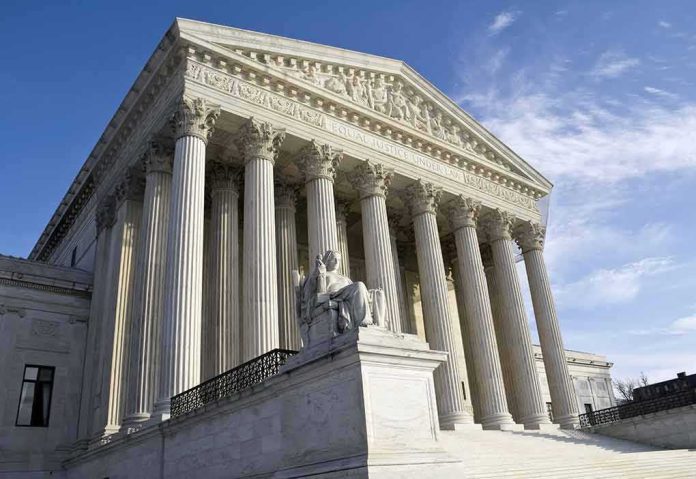
House leaders moved to cement the Supreme Court at nine justices, aiming to stop court packing before it starts.
Story Highlights
- House joint resolutions propose a constitutional amendment fixing the Court at nine justices.
- A Republican-led panel advanced the amendment in the 119th Congress, escalating the push.
- Democratic figures have renewed calls to expand the Court to 13 justices, sharpening the stakes.
- The Court has stood at nine since 1869, and past packing attempts drew fierce backlash.
What The House Is Moving To Do Now
House leadership backed a constitutional amendment to lock the Supreme Court at nine seats. The current text states the Court “shall be composed of nine justices consisting of one chief justice and eight associate justices”. A Republican-led House panel advanced the proposal this summer, setting up floor action and a clear contrast with expansion plans on the left. Supporters say the amendment protects judicial independence and stops a future majority from adding seats to tilt outcomes.
Representative Dusty Johnson has led “Keep the Nine” measures across multiple Congresses, arguing that the only safe guardrail against packing is to put nine into the Constitution itself. Backers frame the move as a simple rule that keeps politics out of the bench size. They emphasize that ordinary laws are too easy to change when tempers run hot, while an amendment forces broad national agreement before the Court’s size can ever shift again.
Why Court Size Became A Flashpoint Again
Democratic leaders and activists have revived expansion plans in recent years. In 2021, congressional Democrats unveiled a bill to grow the Court from nine to 13 seats, saying it would “restore balance” after rulings they opposed. In late August 2026, Representative James Clyburn said Congress should expand the Court to 13, calling it a “baker’s dozen” and tying support to his view of constitutional priorities. These public pushes hardened Republican resolve to constitutionalize the nine-justice norm.
Conservatives warn that packing the Court would not stop at one party’s turn. They argue it would trigger a cycle of retaliation that shreds trust and wrecks the rule of law. They point to history for caution. The size of the Court changed several times in the 1800s, but it has held at nine since 1869. The most famous expansion attempt, President Franklin Delano Roosevelt’s 1937 plan, sparked severe resistance and failed, becoming a lasting warning against politicizing the bench.
How A Constitutional Lock Works — And Why It Matters
Congress can pass an amendment with two-thirds support in both chambers and then send it to the states, where three-fourths must ratify. Supporters say this is the right bar for a rule that shields the Court from power grabs. They argue that a clear nine-justice limit protects equal justice, gun rights, religious liberty, and the separation of powers from partisan waves. They add that families and small businesses need a stable Court, not one that swells every time one side loses key cases.
House Republicans also stress that Democrats have tied expansion to policy goals, not structural needs. They say that is the very definition of court packing. Locking the number at nine would remove that lever and force both parties to win arguments, not seats. The Congressional Research Service notes that the Court’s size has been nine since Reconstruction and that 1937’s attempt was widely viewed as seeking a friendlier Court for a sitting president’s agenda.
What Comes Next — And What To Watch
House action now shifts pressure to the Senate and then to the states. Passage will require bipartisan support, which backers say is part of the point: a nonpartisan shield for a nonpartisan Court. If the amendment advances, states will debate whether to lock in nine or leave Congress free to add seats by statute in the future. Voters should expect sharper messages from both sides as the election season nears and court cases on speech, life, energy, and guns keep the stakes high.
🚨 BREAKING: @SpeakerJohnson says the House will vote tomorrow on a proposed constitutional amendment that would permanently limit the Supreme Court to nine justices, making it harder for future administrations or Congresses to expand the bench.
The measure would need a… pic.twitter.com/sMR4RRPaVh
— Just the News (@JustTheNews) September 1, 2026
For conservatives, the choice is clear: hold the line at nine to protect the Constitution. The nine-justice Court has served Americans through war, peace, and cultural change. A permanent cap keeps judges from becoming politicians in robes and blocks a rush to pack the bench when rulings cut against a party platform. The amendment fight will test whether Washington still can set firm guardrails that outlast any single president or Congress.
Sources:
congress.gov, young.senate.gov, constitutioncenter.org, docs.house.gov, nbcnews.com